Jean Paul Gaultier Fleur du Mâle: The white floral that may simply have arrived too soon
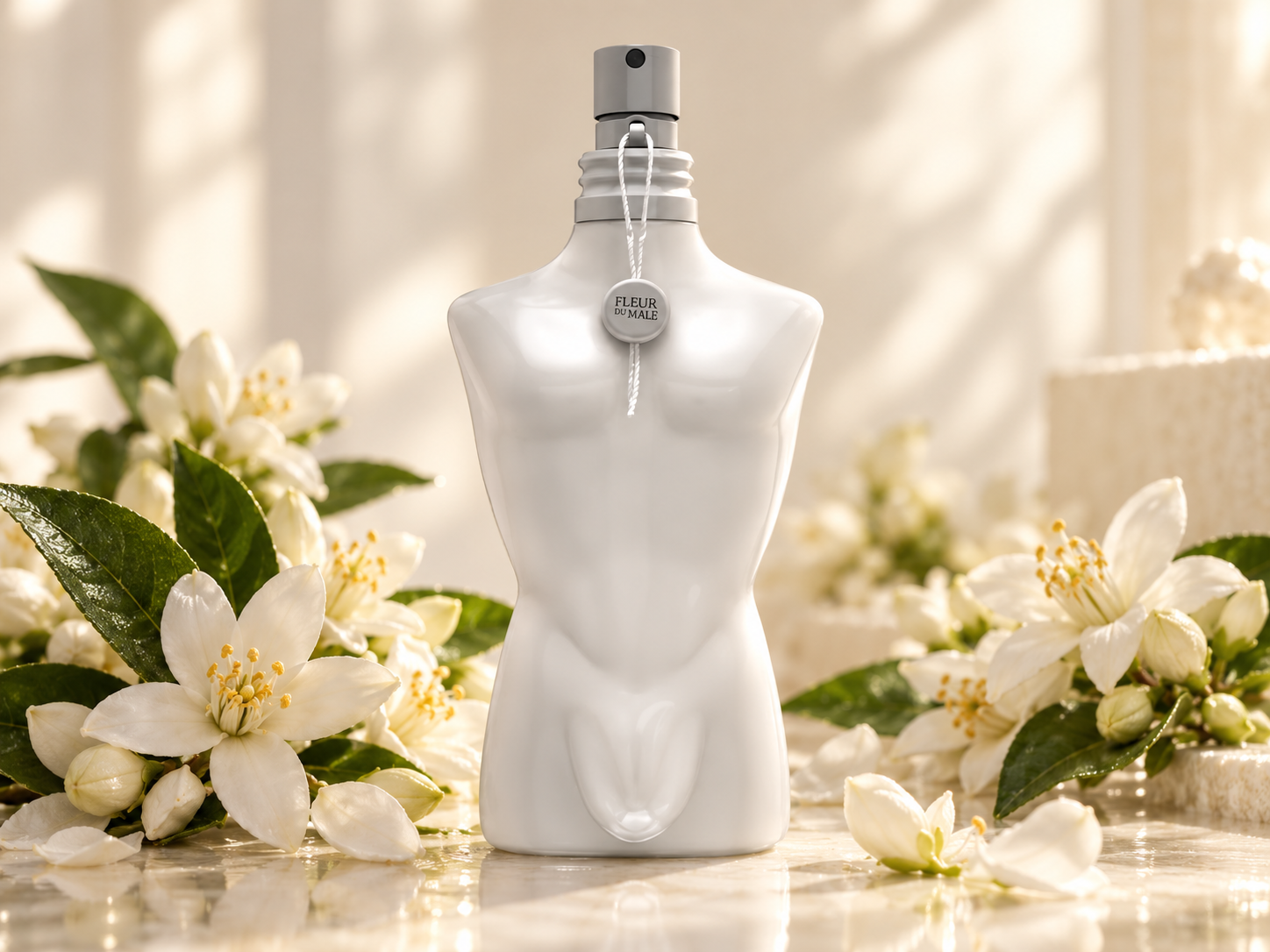
Jean Paul Gaultier Fleur du Mâle did not arrive quietly. It arrived in an immaculate white torso, surrounded by flower petals, carrying one of perfumery’s most innocent-sounding materials at an almost indecent volume. In 2007, when mainstream masculine fragrance still relied heavily on familiar signals of freshness, woods and seduction, Francis Kurkdjian gave men an overdose of orange blossom.
The fragrance has since disappeared from the official Gaultier line, but it refuses to disappear from perfume conversation. That survival is telling. Plenty of discontinued releases become footnotes; Fleur du Mâle became a question: was the perfume unsuccessful, misunderstood, or simply early?
A name with trouble built into it
The joke begins with the name. Fleur du Mâle plays on Les Fleurs du Mal, Charles Baudelaire’s collection of poems, replacing evil with the male body already central to Jean Paul Gaultier’s fragrance universe. It is clever, camp and more serious than it initially appears. The perfume takes a material coded as soft, decorative and traditionally feminine, then places it inside one of the most recognizable masculine bottles in designer perfumery.
Gaultier had never treated gender as a tidy set of instructions. Fleur du Mâle did not ask whether men were allowed to smell floral. It behaved as though the discussion had already ended and moved directly to the petals.

Twelve years after Le Mâle
Jean Paul Gaultier Fleur du Mâle arrived twelve years after Le Mâle, the 1995 blockbuster that had established both Gaultier’s male torso bottle and Francis Kurkdjian’s name in fine fragrance. Bringing Kurkdjian back mattered: this was not an unrelated scent borrowing a famous bottle. It was a new argument built with some of the original’s vocabulary.
Contemporary reviewers noticed the relationship most clearly in the fougère structure. Le Mâle’s aromatic barbershop character remained somewhere in the architecture, but the balance had shifted. The sweet oriental weight was lightened, the floral element was pushed forward and orange blossom moved from supporting role to headline act.
Calling it merely a flanker therefore feels inadequate. Gaultier Fleur du Mâle was closer to a deliberate mutation: recognizable enough to belong to the family, strange enough to risk rejection by it.
The white flower with nothing to hide
Original launch coverage described an intensely floral fragrance created for the man “who has nothing to hide”. Industry reporting also explained that Kurkdjian had overdosed the orange blossom and rebuilt the fougère around petitgrain leaf and coumarin. The concept was not floral by accident or as a hidden nuance. The flower was the proposition.
Petitgrain gave the opening its green, woody bitterness. Orange blossom supplied radiance, sweetness and a more narcotic floral body. The fougère accord connected the composition to the history of masculine perfumery, while coumarin brought a soft hay-like warmth and powdery sweetness. Familiar materials were present, but their hierarchy had been deliberately rearranged.
A note pyramid with conflicting witnesses
One detail deserves clarification. Modern databases do not present a single consistent pyramid. Some list petitgrain, neroli, chamomile and basil; contemporary launch coverage and reviews repeatedly identify petitgrain, orange blossom, a fougère or fern accord and coumarin, with some sources also mentioning lavender. The safest historical reading is therefore the compact launch structure rather than a later database reconstruction.
This does not make the perfume unknowable. It simply means that note pyramids are communication tools, not laboratory formulas. What remains consistent across the period material is the central idea: green petitgrain, an emphatic orange blossom and a powdery aromatic base.
How it was described when it was new
Bois de Jasmin’s 2007 review described a crisp, transparent opening followed by smooth layers of flowers and woods, with coumarin giving the drydown a hay-like and almost pastry-soft powderiness. Another contemporary review at Now Smell This found bitter-orange leaves, a persistent natural-feeling orange blossom and a mossier fougère effect beneath it.
Those accounts suggest a perfume with contrasts rather than a simple clean floral. The opening was green and bitter; the flower was soft but diffusive; the base was familiar, aromatic and sweet. It could feel polished and slightly dirty, innocent in color but not necessarily in behavior. The white bottle was telling only half the truth.
The descriptions also indicate notable presence and longevity. That matters because the perfume’s softness was conceptual, not timid. Gaultier Fleur du Mâle did not whisper orange blossom. It used volume to challenge the assumption that a floral masculine needed to disguise itself behind citrus or woods.
How I remember Gaultier Fleur du Mâle
I have been a Gaultier fan for as long as I can remember, so owning the house’s fragrances once felt almost inevitable. I bought Fleur du Mâle in 2007, the year it was released. Even before smelling it, that glossy white torso made resistance rather unrealistic. It was one of those bottles designed to become an object of desire before the first spray.
I no longer remember its development with enough precision to reconstruct a complete review, and I do not want nostalgia to fill in details that memory has lost (I’m old). What remains is a strong impression of texture and scale. I remember it as enveloping and almost creamy, extremely persistent, with a trail that could make its presence known from a serious distance. It was powerful, but never clownish: important rather than ridiculous, generous rather than desperate for attention.
Those memories also make the descriptions published in 2007 feel recognizable. The creaminess I remember may have come from the interaction between orange blossom, coumarin and the aromatic base, but that is an interpretation made years later, not a note-by-note recollection. The honest memory is simpler: Gaultier Fleur du Mâle surrounded me, stayed with me and somehow made a white flower feel completely at home on a masculine torso.
Masculinity, dressed entirely in white
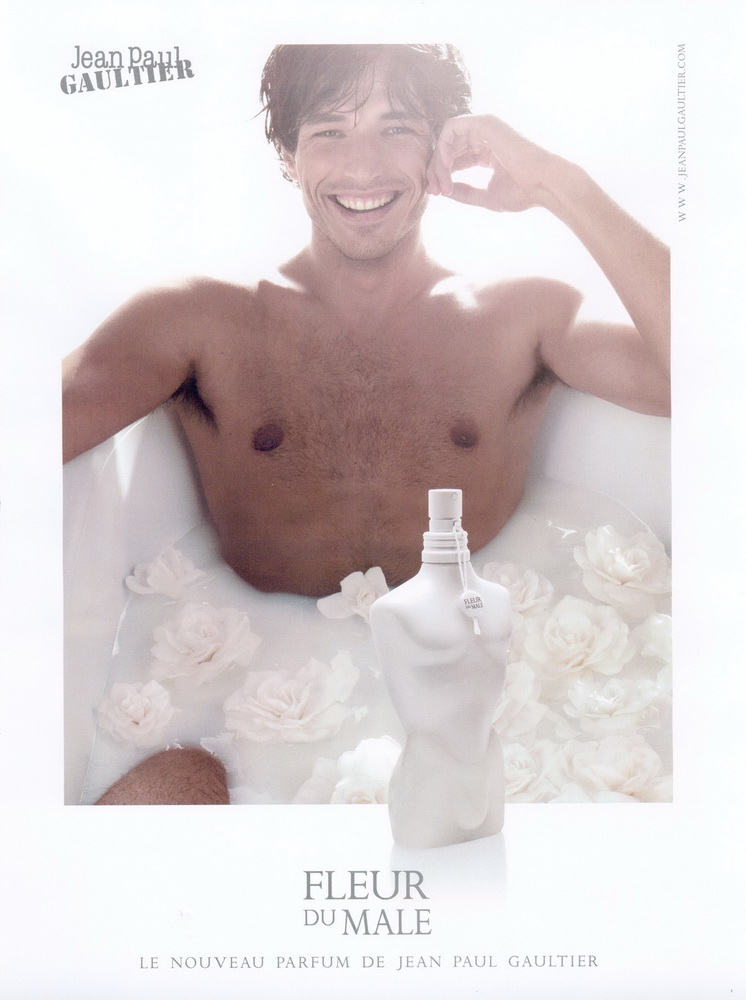
The bottle translated the original Gaultier torso into opaque white glass and placed it inside a matching white tin. The campaign, photographed by Jean-Baptiste Mondino, showed model Andrés Velencoso Segura in a bath filled with white petals and gardenias. Instead of the sailor fantasy and theatrical machismo associated with Le Mâle, the image offered exposed skin, flowers and an almost serene sensuality.
In 2007 this was not the only designer fragrance questioning masculine conventions. Dior Homme had made iris central two years earlier, while Terre d’Hermès had presented a mineral, earthy alternative to conventional seduction in 2006. Gaultier Fleur du Mâle entered the same broader conversation from a different door. It did not make masculinity darker, sharper or more intellectual. It made it floral.
That distinction may explain both its fascination and its difficulty. A man could wear orange blossom, of course; cologne had proved that for centuries. Asking him to buy an opaque white torso advertised through a bath of petals was a more visible decision. The fragrance did not only smell different. It required the customer to be comfortable with what the bottle appeared to say.
Why was Jean Paul Gaultier Fleur du Mâle discontinued?
There is no reliable official statement explaining why Gaultier Fleur du Mâle was withdrawn, and it would be dishonest to turn speculation into corporate history. Contemporary perfume writing shows that by 2011 the fragrance was already being discussed as “gone but not forgotten”, although remaining stock could still be found in some shops.
The usual explanations are plausible but unproven: sales may not have justified a permanent place beside Le Mâle; the overtly floral positioning may have narrowed its audience; or the product may simply have become inconvenient as licences, ranges and commercial priorities evolved. None of these possibilities has been confirmed by the brand.
What can be said is simpler. Le Mâle became an institution. Gaultier Fleur du Mâle became a cult memory. Commercial longevity and creative value are not the same metric, however much retail would enjoy the convenience.
I have never entirely understood the logic that makes a house remove a fragrance with a recognizable identity. It felt especially baffling decades ago, when launches arrived at a far slower rhythm and each disappearance seemed less like routine catalogue maintenance. Today thousands of new fragrances compete for attention and brands remove products almost as quickly as collectors discover them. The result, at least for me, is the peculiar joy of fragrance FOMO: another perfume vanishes just before I manage to buy it.
Was it simply ahead of its time?
Calling every discontinued perfume “ahead of its time” is an easy way to romanticize a product that may simply not have sold. Fleur du Mâle deserves a more careful verdict. It was not the first floral fragrance for men, and orange blossom had a long masculine history. What felt unusually progressive was the lack of camouflage: the floral identity appeared in the formula, the name, the bottle and the advertising at the same time.
From today’s perspective, when gendered fragrance rules carry less authority and white florals appear comfortably across every department, the concept looks remarkably natural. That does not prove it would become a bestseller if relaunched. It does suggest that the cultural resistance surrounding it would be weaker.
A return would also test whether nostalgia is attached to the perfume itself or to the freedom it represented. The temptation would be to bring it back as an Elixir, darken the bottle, add vanilla and oud, and insist that the petals had developed a gym membership. The more interesting decision would be to restore the white torso and let orange blossom remain the provocation.
Could the white torso be returning?
At the time of writing, this is no longer an entirely hypothetical question. Gaultier has begun teasing another entry in its Reéditions project, describing a missing silhouette from almost twenty years ago, a lively freshness, a surprising flower and a sensuality that settles without imposing itself. The brand has not yet named Fleur du Mâle on a searchable official product page, but the clues have prompted credible reports that the 2007 fragrance will return in September 2026.
That distinction matters. A suggestive campaign is evidence of an imminent re-edition, but it is not yet confirmation of the final formula, bottle, perfumer credit or market availability. Until Gaultier reveals the product completely, “Fleur du Mâle is returning” should remain a strongly supported expectation rather than a finished fact.
If the missing silhouette really is that glossy white torso, then perhaps my prayers are about to be answered. I would still want to smell the new version before calling it a faithful return. Memory may be imprecise, but it remembers creaminess, persistence and a magnificent trail. The revived flower will have rather large petals to fill.
A flower that outlived its shelf space
Fleur du Mâle remains compelling because its disappearance did not make its idea obsolete. Francis Kurkdjian took the familiar grammar of a masculine fougère, flooded it with orange blossom and allowed softness to become a form of confidence. Gaultier then gave that idea a body: white, bare and surrounded by petals.
The fragrance may no longer occupy a shelf in the current collection, but it still occupies a clear place in perfume history. It reminds us that discontinued does not mean failed, and successful does not always mean courageous. Sometimes the perfumes that vanish are the ones that make the present look slightly less original.
To understand the material at the centre of Fleur du Mâle, continue with Neroli vs Orange Blossom. To explore another unapologetically physical white floral from a different era, read Robert Piguet Fracas.
| Because apparently our wish lists are not allowed to rest, you can discover the latest launches in New Releases. |