Pantheon Roma Donna Margherita: Tuberose, Art and a Renaissance Love Story
| Editorial note: This Fragrance Focus is based on official information supplied by Pantheon Roma and published historical sources. I have not tested Donna Margherita on skin, so this is not a review and contains no personal assessment of its smell, longevity or projection. |
Pantheon Roma Donna Margherita begins with an irresistible premise: what if the scent of a woman’s skin had helped derail the concentration of one of the Renaissance’s greatest artists?
It is an excellent perfume story. It is also the kind of story that becomes suspiciously tidy after five centuries of retelling. Pantheon Roma builds Donna Margherita around Margherita Luti, traditionally identified as Raphael’s lover and muse, and translates her legendary sensuality into tuberose, jasmine, narcissus, frangipani, lily of the valley, amber and white musk.
The result, at least on paper, is not a shy bouquet. Tuberose appears twice in the official pyramid, the bottle is dressed in black and gold, and the inspiration involves art, desire and a romance that history has never managed to leave alone. Subtlety was apparently invited, saw the guest list and stayed home.
The Woman Behind Pantheon Roma Donna Margherita
Margherita Luti is commonly associated with La Fornarina, Raphael’s portrait of a partially nude young woman painted around 1518–1519 and now held at Palazzo Barberini in Rome. She is also frequently linked to La Velata, although certainty becomes elusive very quickly when biography, attribution and centuries of romantic storytelling begin to overlap.
Even the familiar name “La Fornarina” arrived after Raphael’s lifetime. It means “the baker’s daughter” and reflects the tradition that Margherita was the daughter of a baker from Siena living in Rome. The surviving documentary record is thin; the cultural afterlife is enormous. Painters, writers and filmmakers repeatedly turned Raphael and his supposed muse into the archetypal artist-and-model love affair.
Pantheon Roma embraces that afterlife. In the house narrative, Margherita is a young woman from the Roman neighbourhoods whose beauty, gaze and distinctive skin scent captivate Raphael. She becomes not simply a model but the emotional centre of a perfumed Renaissance drama.
That distinction matters. We can say that Margherita Luti has long been identified by tradition as Raphael’s lover and muse. We cannot verify that her natural perfume made him fall in love. Tragically, the sixteenth century was not especially diligent about recording fragrance wear tests.
Raphael, Rome and a House Built Around a Love Story
The connection extends beyond a single perfume. Pantheon Roma takes its name and identity from the city in which Raphael lived and worked—and from the monument where he was buried after his death in 1520. The brand’s wider collection revisits episodes, characters and imagined atmospheres surrounding the artist’s Roman years.
Donna Margherita therefore operates as a character portrait within a larger narrative. Rather than attaching an arbitrary historical name to a generic floral composition, the house uses white flowers and amber to construct its version of Margherita: luminous, sensual and difficult to resist.
The approach could easily collapse into costume drama. What keeps it interesting is the choice of tuberose. Few materials carry such a persuasive mixture of beauty and danger.
Tuberose Takes the Leading Role
Pantheon Roma describes Donna Margherita as a deep, enveloping floral centred on seductive tuberose. The official structure opens with jasmine and tuberose; the heart repeats tuberose alongside narcissus, frangipani and lily of the valley; amber and white musk form the base.
Repeating tuberose at the top and heart is less a technical map than a declaration of intent. The flower is not waiting politely for its allotted stage of development. It is presented as the fragrance’s continuous presence.
In perfumery, tuberose can suggest cream, green stems, waxy petals, mentholated coolness, ripe fruit and something almost bodily. That ability to move between immaculate white petals and physical sensuality makes it particularly suited to the legend of Donna Margherita. A rose might have made the romance obvious. Tuberose makes it slightly dangerous.
The brand also repeats a popular historical claim: that tuberose was considered so sensual in the Renaissance that young women were forbidden to use it. It is a wonderfully effective anecdote, but reliable evidence for a specific sixteenth-century ban is difficult to establish. It is safer to read it as part of tuberose mythology—a story that reveals the flower’s reputation, even if it should not be treated as a documented regulation.
Reading the Official Note Pyramid
The opening pairs jasmine with tuberose. On paper, that suggests immediate floral volume rather than a conventional citrus prelude. Jasmine can bring radiance and diffusion, while tuberose supplies the dense, creamy body around which the composition is organized.
The heart expands the white-floral idea. Narcissus often contributes a greener, earthier and faintly animalic shadow; frangipani can introduce a soft tropical creaminess; lily of the valley offers a fresher, more translucent floral effect. Together, they imply contrast inside the bouquet rather than four flowers competing to deliver the same message.
Amber and white musk then provide the expected transition from petals to skin. The amber promises warmth and depth, while white musk can soften the composition and extend its clean, enveloping aura. Pantheon’s own description emphasizes a persistent trail, but until the fragrance is tested, that remains the brand’s performance claim rather than my verdict.
Official notes
Top: jasmine, tuberose
Heart: tuberose, narcissus, frangipani, lily of the valley
Base: amber, white musk
A Bottle That Refuses Renaissance Modesty
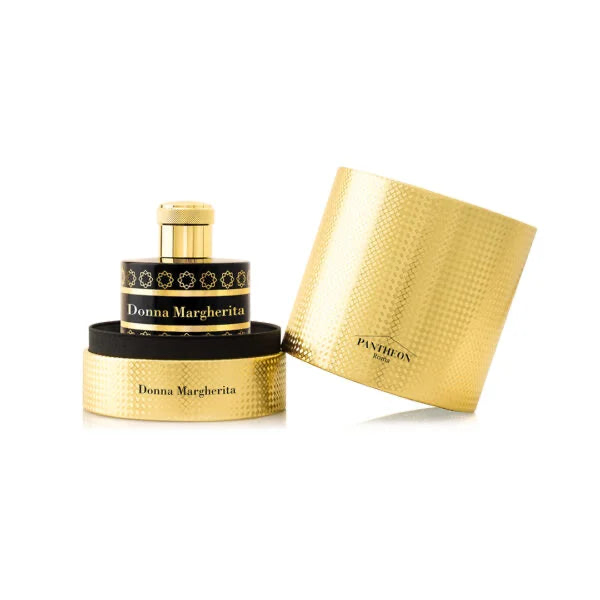
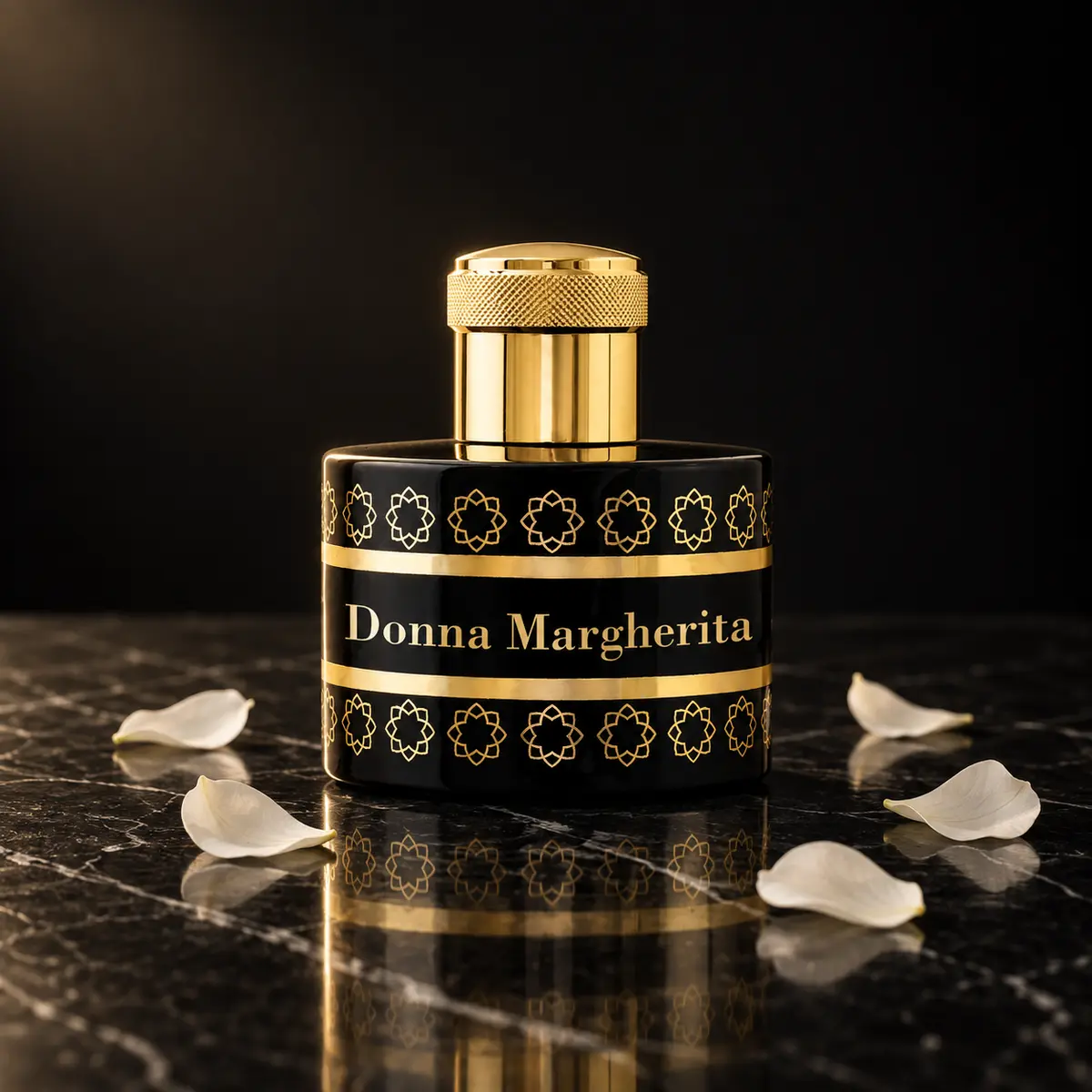
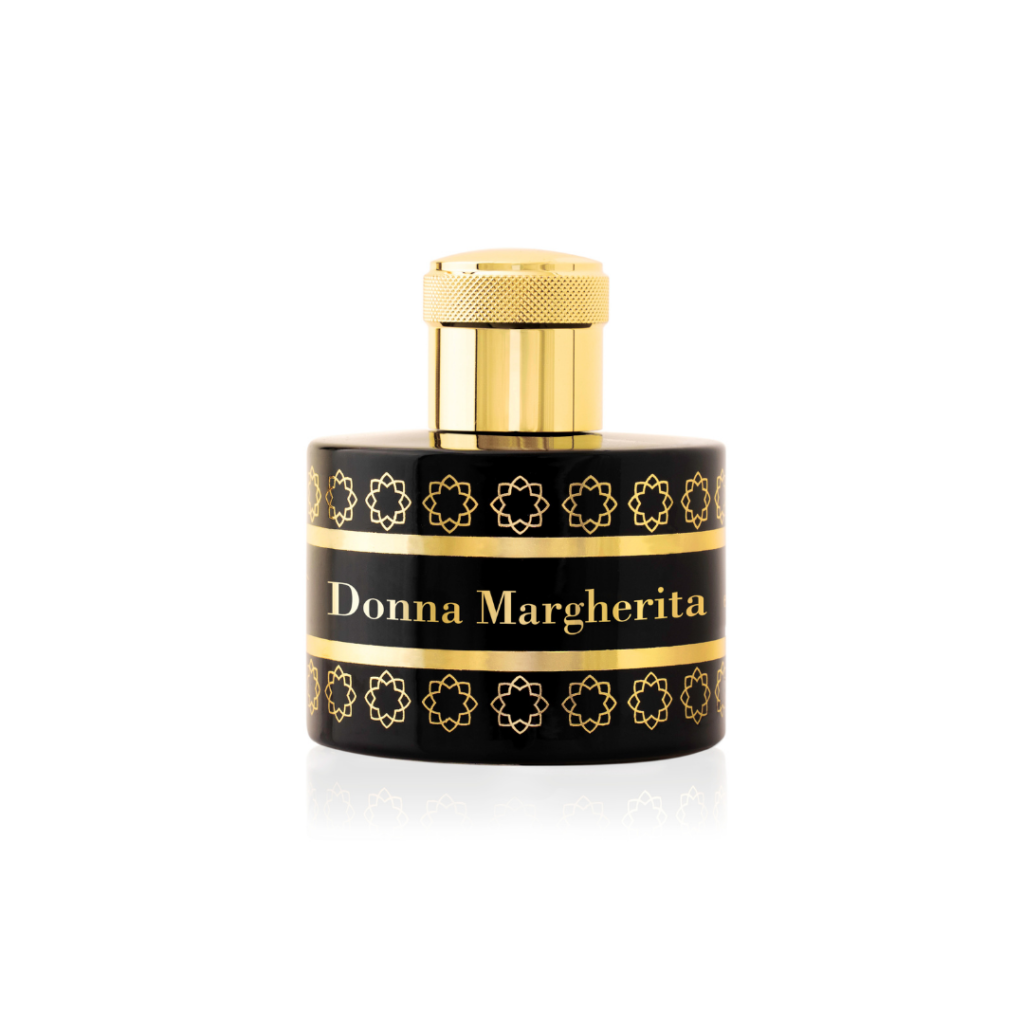
The current black presentation makes the concept immediately legible. Donna Margherita comes in a broad cylindrical bottle with a glossy black body, gold bands, repeated floral ornament and a substantial gold cap. It looks less like a delicate bouquet and more like an object stored in a particularly glamorous private chapel.
That visual weight is useful. White-floral perfumes are often presented through brightness, purity and pale petals. Pantheon instead places the flowers against black lacquer and gold. The contrast suggests that this is not meant to be an innocent portrait of femininity. The petals may be white; the intention is considerably darker.
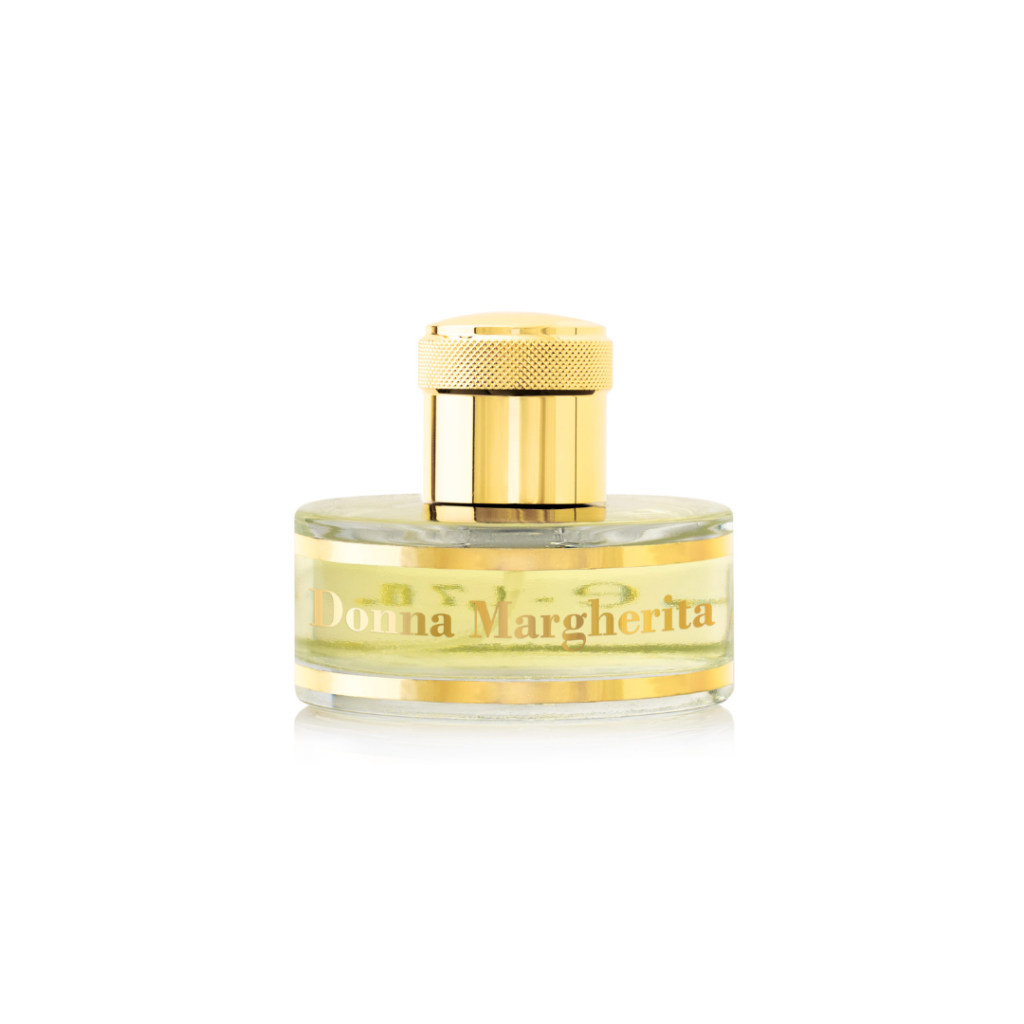
Official imagery for the fragrance has also shown a clear-glass presentation, while the current product page foregrounds the black bottle. Unless the brand provides a detailed packaging chronology, the images are best treated as different presentations rather than evidence of a reformulation. A bottle change tells us what the object looks like, not automatically what happened to the liquid inside.
What We Can Say Without Smelling It
A fragrance can be interesting before it becomes reviewable. Donna Margherita has a coherent connection between subject, material and presentation: a legendary muse becomes a tuberose portrait; white flowers express attraction; amber and musk bring the composition closer to warm skin; black and gold prevent the story from becoming too innocent.
What I cannot tell you yet is whether the jasmine feels luminous or indolic, whether the tuberose leans green or creamy, how clearly the narcissus and frangipani emerge, or whether the amber dominates the drydown. I also cannot confirm the “persistent and unforgettable” trail promised by the official description. Those questions require skin, time and preferably more than one wearing—not confidence performed from behind a note pyramid.
This is why Fragrance Focus exists. A perfume can deserve context and curiosity without being subjected to an imaginary review. Donna Margherita has already supplied art history, romantic mythology, a potentially unruly bouquet and a bottle with absolutely no interest in minimalism. That is quite enough material for an introduction.
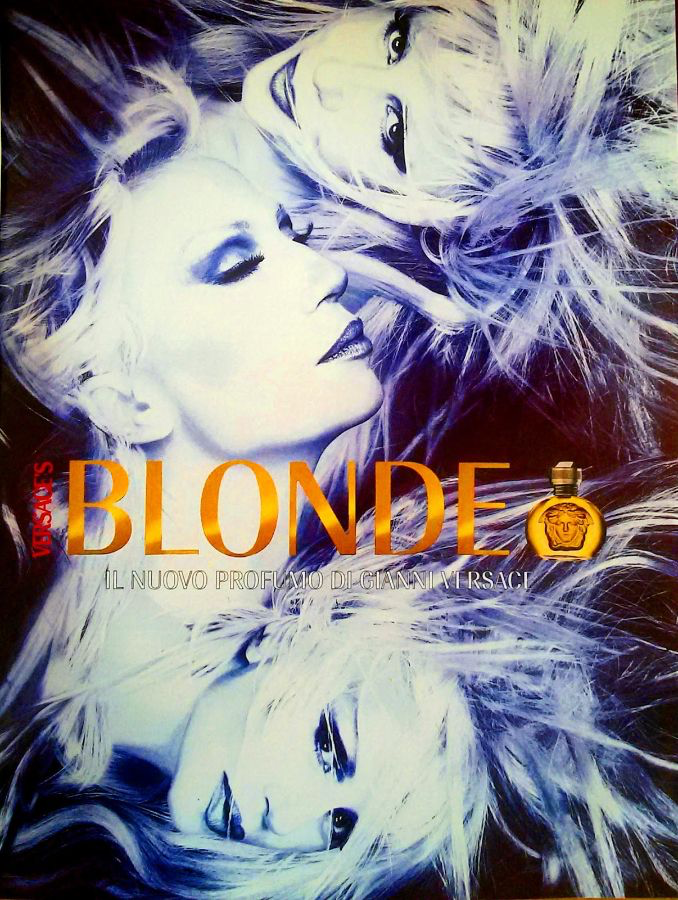
| If tuberose behaving badly is your idea of cultural enrichment Pantheon Roma Donna Margherita is not the first fragrance to turn this white flower into a full-scale personality. Revisit Versace Blonde, the discontinued tuberose legend—a perfume that treated restraint as a problem for other people. |
The Romance Is the Point—but So Is the Footnote
Perfume has always borrowed from history because history offers instant atmosphere. Names such as Raphael and Margherita bring Rome, painting, secrecy and desire into the room before the bottle is opened. The danger is that a compelling story can become more precise each time marketing repeats it.
Pantheon Roma Donna Margherita works best when we allow both things to coexist. There was a Renaissance master named Raphael. A woman traditionally identified as Margherita Luti became inseparable from the mythology surrounding some of his most intimate portraits. Their supposed relationship has fascinated later generations. Pantheon Roma has transformed that cultural legend into a floral extrait.
The scent of her skin making Raphael lose his reason? Impossible to prove. Excellent copy? Absolutely.
Final Thoughts
Pantheon Roma Donna Margherita presents tuberose as seduction, jasmine as radiance and amber as the warmth left after the encounter. Its inspiration may live somewhere between history and beautifully embroidered legend, but the perfume’s concept is unusually complete: story, notes and bottle all speak the same language.
I still need to smell it before deciding whether the fragrance itself is as magnetic as the woman Pantheon describes. For now, it earns attention for doing something more ambitious than assembling an attractive floral pyramid. It turns a five-hundred-year-old love story into a bottle—and leaves tuberose to handle the scandal.