
Nuance Parfums: The Beauty of What Lies Between
Three perfumers, three fragrances and a French perfume house exploring the many personalities hidden within familiar ingredients.
Perfume has a rather complicated relationship with subtlety.
Some fragrances want to make an entrance. Others seem determined to announce their presence before their wearer has even entered the room. And then there are perfume houses that take a slightly different approach, asking us to pay attention not necessarily to what is immediately obvious, but to what gradually reveals itself.
Nuance Parfums belongs, at least in philosophy, to this last category.
The French niche perfume house has built its creative identity around a deceptively simple idea: no ingredient has only one personality.
Vanilla can be comforting, certainly, but it can also be smoky, woody or unexpectedly dark. Oud doesn’t necessarily have to dominate an entire composition. And musk, perhaps one of perfumery’s most versatile materials, can express far more than the familiar sensation of freshly washed skin.
It all depends on how these materials are interpreted.
And that is where Nuance Parfums begins.
A Different Way of Looking at Perfume
The philosophy behind Nuance Parfums revolves around perception.
Rather than treating ingredients as fixed olfactory identities, the house explores their different facets, almost as a painter might experiment with light, shadows and color.
A material changes depending on what surrounds it. Some characteristics become more pronounced, while others retreat into the background. What initially appears familiar may eventually reveal something entirely unexpected.
It’s an appealing concept, particularly in a fragrance landscape where originality is sometimes confused with increasingly extravagant combinations of notes.
After all, does the world really need another perfume containing seventeen ingredients competing for attention?
Probably not.
What it could always use, however, is another interesting interpretation of something we thought we already knew.
Nuance Parfums approaches fragrance as a spectrum rather than simply a traditional olfactory pyramid. The objective is not necessarily to transform an ingredient beyond recognition, but to explore its possibilities while preserving its identity.
And to translate that philosophy into actual fragrances, the house has chosen three different creative voices.
Three Perfumers, Three Interpretations
One of the most interesting aspects of Nuance Parfums is its decision to collaborate with different perfumers rather than relying on a single creative signature.
The initial collection brings together Clément Marx, Sidonie Lancesseur and Serge de Oliveira, each responsible for a fragrance built around a distinctive olfactory direction.
This approach creates an interesting balance.
There is a common philosophy connecting the collection, yet each composition has room to express an individual interpretation of that philosophy.
Of course, an attractive creative concept means relatively little if the fragrances themselves cannot support it.
But on paper, the three creations offer three rather different perspectives.
Vanille Ébène: Vanilla After Dark
Perfumer: Clément Marx
Vanilla has become one of the most predictable ingredients in contemporary perfumery.
Not because the material itself lacks complexity, but because so many fragrances seem perfectly content to interpret it as another variation on dessert.
Nuance Parfums appears interested in something different.
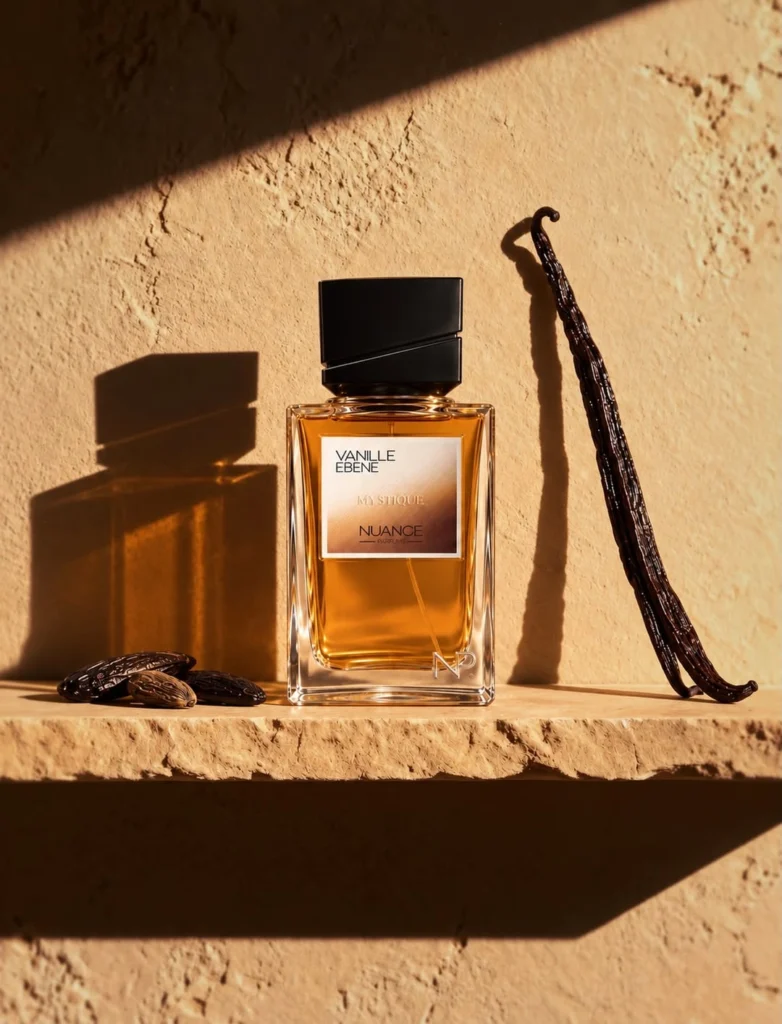
Created by Clément Marx, Vanille Ébène explores the darker, more textured personality of vanilla.
Bourbon vanilla absolute and vanilla infusion establish the central theme, while black pepper introduces a contrasting spicy dimension.
Jamaican rum CO₂ extract adds a potentially intriguing boozy facet, and tonka bean contributes warmth and roundness.
The composition also incorporates Indian papyrus and fractionated patchouli, suggesting a drier, more structured interpretation of vanilla, far removed from the usual confectionery associations.
It is precisely this combination that makes Vanille Ébène interesting.
Not because vanilla, rum and tonka are revolutionary companions, but because the presence of papyrus, pepper and patchouli suggests an attempt to give the familiar ingredient a different texture.
Whether the result genuinely moves beyond the increasingly crowded world of dark vanilla fragrances remains to be discovered.
But the intention is certainly promising.
And considering my relationship with vanilla perfumes, I suspect this is one I would have considerable difficulty ignoring.
Oud Berry: When Fruit Meets Darkness
Perfumer: Sidonie Lancesseur
Oud and fruit are hardly strangers.
What makes Oud Berry potentially interesting, however, is the particular selection of fruity and structural elements surrounding its central woody theme.

Created by Sidonie Lancesseur, the fragrance introduces myrica rubra, blueberry and blackcurrant bud absolute.
Rather than relying on a generic sweet red-fruit accord, this combination suggests several possible directions, from juicy brightness to darker, greener or more tart facets.
The heart introduces saffron, vetiver and Indian papyrus, materials that could provide a welcome counterbalance to the fruit.
Finally, oud, leather and labdanum establish the deeper foundation of the composition.
According to the house’s description, the intention is to allow these elements to gradually blend into a unified olfactory texture rather than remain in constant opposition.
I find that idea particularly appealing.
Too many fruity oud fragrances seem determined to make their two principal elements compete for attention.
Here, the concept suggests something more integrated.
Whether Oud Berry achieves that balance on skin is another matter, naturally. Reading a note pyramid is fascinating, but it is not quite the same thing as wearing the perfume.
Otherwise, my collection would be considerably smaller and my bank account much happier.
Musk Al Layl: The Quiet Side of the Night
Perfumer: Serge de Oliveira
Of the three fragrances, Musk Al Layl might have the most intriguing contrast between its apparent softness and the complexity of its composition.
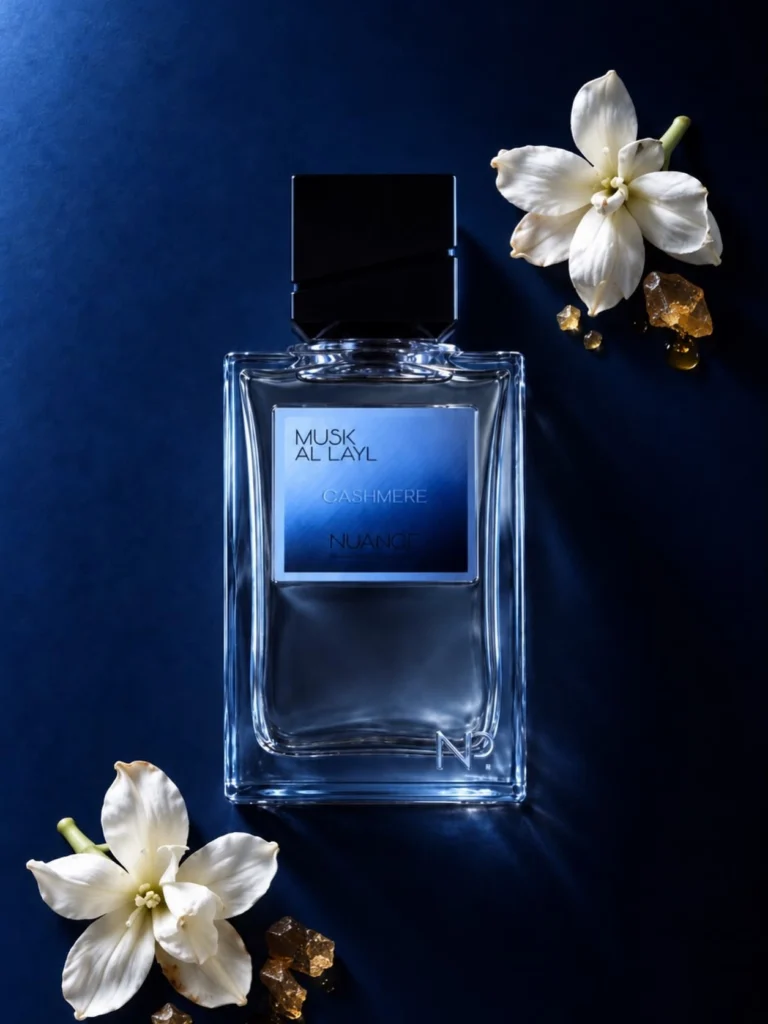
Created by Serge de Oliveira, it explores musk through a nocturnal, intimate atmosphere.
The opening combines bergamot, elemi, freesia and night-blooming jasmine.
In the heart, frangipani, fig, cananga and cashmere wood introduce a combination of floral, fruity and soft woody elements.
The base brings together musks, incense, labdanum absolute and vanilla milk.
On paper, this is an especially attractive collection of materials.
The presence of jasmine and frangipani immediately catches my attention, while incense and labdanum suggest that the musky foundation might possess more depth than a conventional clean-skin fragrance.
What interests me most is the potential relationship between these elements.
Musk can sometimes feel almost abstract, a sensation of softness rather than a clearly identifiable note. Combining it with creamy florals, fig and incense creates the possibility of something both comforting and slightly mysterious.
Nuance Parfums presents Musk Al Layl as a fragrance associated with stillness, closeness and the gradual arrival of night.
It sounds beautiful.
Now comes the inconvenient part: discovering whether it smells as beautiful as it reads.
A Visual Identity Built Around Light
The brand’s approach to nuance also extends to its presentation.
Rather than adopting an excessively elaborate bottle design, Nuance Parfums uses a contemporary silhouette with a distinctive chevron pattern worked into the glass.
The surface interacts with light, creating subtle changes in appearance depending on the viewing angle.
It’s a detail that connects naturally with the house’s central idea of shifting perception.
I appreciate this kind of visual consistency.
A bottle doesn’t necessarily need to resemble a piece of architecture from another planet to communicate an identity.
Sometimes a carefully considered detail is enough.
And in a market where increasingly theatrical packaging occasionally seems to receive more attention than the fragrance inside, a little restraint can be refreshing.
Three Fragrances, One Creative Direction
The collection currently presented by Nuance Parfums consists of three eaux de parfum, each offered in a 100 ml bottle.
All three are listed at €140 on the official website.
The house also offers a discovery set containing 2 ml samples of each fragrance, priced at €18 at the time of writing. According to the brand, the discovery-set price can subsequently be deducted from the purchase of a full bottle.
That last detail deserves some appreciation.
Discovering a new perfume house should be an invitation to explore, not an immediate commitment to spending three figures on a fragrance you’ve never smelled.
Particularly when the brand’s entire philosophy revolves around appreciating subtleties that may only become apparent through actual wear.
A discovery set is, quite simply, the sensible way to begin.
An unfamiliar concept in perfume collecting, I know.
Beyond the Marketing Language
Naturally, there is one important distinction worth making.
Nuance Parfums has developed an attractive creative narrative, but an attractive narrative is not automatically evidence of exceptional perfumery.
The niche fragrance market is full of beautiful descriptions, evocative imagery and ambitious declarations about reinventing familiar ingredients.
Sometimes the fragrances deliver.
Sometimes the storytelling is rather more sophisticated than the contents of the bottle.
And sometimes a perfume surprises us in ways that no official description could possibly communicate.
What makes Nuance Parfums worthy of attention, in my view, is not a claim of revolutionizing perfumery.
It is the coherence of its proposition.
Three familiar olfactory territories. Three different perfumers. Three compositions apparently designed to explore the subtleties of their central materials.
There is enough here to make me curious.
And curiosity, rather than hype, is generally a much better reason to discover a perfume house.
Final Thoughts: A Matter of Perspective
I haven’t smelled the Nuance Parfums collection yet, so this Brand Focus is an introduction to the house and its creative philosophy rather than a verdict on the fragrances themselves.
Still, there is something appealing about a brand that encourages us to reconsider ingredients we encounter almost every day.
Vanilla doesn’t always need to be edible. Oud doesn’t always need to be imposing. Musk doesn’t always need to smell like freshly laundered sheets.
Sometimes the most interesting creative decision isn’t adding something new.
It’s discovering what was already there.
And perhaps that is the most compelling idea behind Nuance Parfums.
The beauty isn’t necessarily in the ingredient itself, but in the nuances we haven’t noticed yet.
| Editorial transparency: This article is based on information provided by Nuance Parfums through its official website. The fragrances discussed have not yet been personally tested. Olfactory descriptions and interpretations are therefore based on the brand’s published compositions and creative presentations, not firsthand wearing experiences. |