Perfume Projection, Sillage and Longevity: What They Actually Mean
Perfume projection and sillage are often treated as interchangeable terms. Add longevity, diffusion and the wonderfully dramatic phrase beast mode, and a simple question – how does this perfume behave when worn? – suddenly begins to sound like an advanced physics exam.
The good news is that the basic distinctions are easy. Longevity tells us how long a fragrance remains detectable. Projection describes how far it radiates from the wearer. Sillage is the trail it leaves in the air, especially as the wearer moves. Performance is the umbrella term people commonly use for all of these behaviors.
They influence one another, but they are not the same. A fragrance can last all day and stay close to the skin. Another can project powerfully for an hour and then collapse with the theatrical timing of a soap-opera villain. Calling both of them simply “strong” does not tell us much.
The Short Version
| Term | What it describes | The useful question |
|---|---|---|
| Performance | The overall behavior of a fragrance | How does it behave from application to drydown? |
| Longevity | How long it remains detectable | Can I still smell it after several hours? |
| Projection | How far it radiates from the wearer | How large is the scent bubble around me? |
| Sillage | The scented trail left in the air | Does it linger as I move through a space? |
| Diffusion | How effectively the scent disperses through the air | Does it feel airy and expansive or dense and close? |
| Skin scent | A fragrance detectable mainly at close range | Does someone need to be near my skin to smell it? |
| Drydown | The later stage of the fragrance’s development | What remains after the opening has faded? |
None of these terms is a universal score for quality. They describe behavior, not beauty. A cathedral and a whispered secret can both be impressive; they are simply doing different jobs.
What Does Perfume Performance Mean?
In fragrance conversations, performance is a convenient umbrella term. It usually covers longevity, projection and sillage, and sometimes includes how quickly a fragrance changes or how stable its presence feels over time.
The problem begins when performance is reduced to one number. “Performance: 9/10” sounds decisive, but what earned the nine? Ten hours of quiet wear? Three hours of enormous projection? A trail that remains in a hallway after the wearer has gone? Without context, the score is wearing a very confident outfit and carrying no identification.
A useful performance description should therefore explain at least two things: how long the fragrance remained detectable and how far it seemed to radiate. Sillage can then be added when it was actually observable.
Perfume Longevity: How Long Does It Last?
Longevity is the simplest concept: it is the amount of time a fragrance remains detectable after application.
The important word is detectable. A perfume may stop projecting after two hours but remain clearly noticeable on the skin for another six. If you only judge it from across the room, you may declare it dead while it is quietly continuing its life on your wrist.
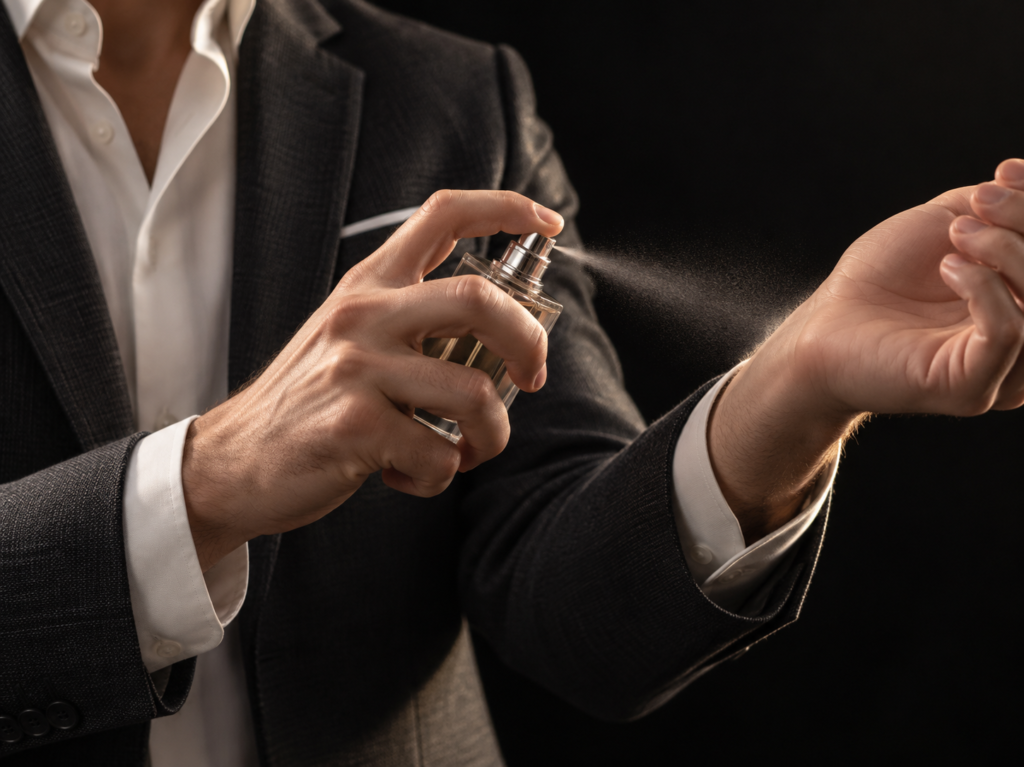
Longevity also changes through stages. The opening may be bright and obvious, the heart softer, and the drydown a faint trace that appears only when you bring your nose close. Saying that the perfume lasted eight hours is useful, but saying that it projected for two hours and remained a skin scent until hour eight is much more informative.
And no, longevity is not automatically quality. Twelve hours with a fragrance you dislike is not better value. It is a hostage situation.
Perfume Projection and Sillage: The Difference
Projection Is the Space Around You
Projection describes how far the fragrance radiates away from your body at a particular stage of wear. Think of it as a scent bubble.
Some fragrances create a wide, obvious bubble during the opening and then gradually pull closer. Others remain relatively intimate from the start. Projection is not fixed for the entire life of a perfume, which is why a single label such as “strong projection” can still be incomplete.
It is also difficult to assess accurately by smelling your own wrist every three minutes. Your nose adapts to a continuous stimulus, and repeated close-range sniffing can make the fragrance feel flatter or less present than it is to somebody entering the room.
Sillage Is the Trail Behind You
Sillage is the scented trail a fragrance leaves as the wearer moves through the air. The word comes from the French term for the wake left by a boat. It is a useful image: projection is the aura around the boat; sillage is what remains behind it.
A perfume can project moderately while leaving a noticeable trail in motion. Another may feel very strong when someone stands beside you but leave relatively little behind once you have moved away. This is why projection and sillage should not be used as synonyms.
Sillage is also particularly difficult to judge on yourself. You are moving with your own fragrance cloud, not standing behind yourself in the corridor like an extremely committed ghost. Feedback from another person can help, but one compliment – or the absence of one – is not a calibrated measurement.
| For another perspective on the difference between projection, longevity, and the trail a fragrance leaves behind, Marc-Antoine Barrois offers a beautifully visual explanation of sillage. |
What Is Diffusion?
Diffusion describes the way a fragrance spreads through the air. In everyday fragrance writing, the term often helps explain texture: a scent can feel airy, radiant and expansive even when it is not brutally loud.
This is where some musks, transparent woods and luminous floral materials can create the impression of a fragrance suspended around the body rather than sitting densely on the skin. That sensation should not be confused with simple volume. A composition can diffuse beautifully without attempting to redecorate the respiratory system of everyone nearby.
Projection describes the perceived reach. Diffusion helps describe the manner in which the scent travels and occupies space.
What Is a Skin Scent?
A skin scent stays close to the wearer and is mainly detectable at intimate range. Sometimes this behavior is intentional: the fragrance is designed to feel private, soft or tactile. Sometimes a perfume simply reaches this stage after its initial projection has faded.

Calling something a skin scent is not necessarily criticism. The term becomes useful criticism only when the behavior clashes with the product’s promise, the wearer’s needs or the price being asked. An intimate fragrance can be exquisite. An allegedly room-filling elixir that whispers for forty minutes may require a more awkward conversation.
Drydown Is Not Another Word for Longevity
The drydown is the later stage of a fragrance’s development, after the most volatile opening materials have faded and the longer-lasting structure becomes more prominent.
It tells us what the fragrance becomes, not automatically how long it lasts. A beautiful drydown may appear after one hour and remain for six. A linear fragrance may change very little but still last all day. Development and duration are related parts of the wearing experience, not identical concepts.
This is also why “I loved the opening” is only half a review. The opening is the entrance. The drydown is the person who stays for dinner.
Does a Higher Concentration Mean Better Performance?
Not reliably.
Terms such as Eau de Toilette, Eau de Parfum, Parfum and Extrait generally refer to concentration ranges, but the formula itself matters enormously. A higher concentration can make a fragrance richer, denser or longer-lasting while producing less lift than a lighter version. An Eau de Toilette may project more brightly; a Parfum may remain closer to the skin but last longer.
Different versions of the same fragrance may also be reformulated or creatively reinterpreted rather than simply diluted at different strengths. Reading Parfum on the bottle is therefore not a legal guarantee that the perfume will cross the street before you do.
The composition, the materials and their balance matter more than the concentration label alone.
Why Perfume Performance Varies
Performance is not experienced under laboratory-identical conditions. Several variables can change what you perceive:
- Application: two sprays on a wrist will not behave like eight sprays across skin and clothing.
- Skin and moisture: perfume can behave differently on dry, moisturized or naturally oilier skin.
- Temperature and airflow: heat, cold, humidity, indoor heating and moving air can all alter how quickly a scent seems to bloom or fade.
- Skin versus fabric: clothing may retain a fragrance longer, but it can also change its development and may be stained by some formulas.
- Olfactory adaptation: your brain can reduce its attention to a constant smell even while other people still perceive it.
- Material-specific anosmia: some people are less sensitive to particular aroma molecules, especially certain musks and modern woody materials.
- Storage and sample condition: heat, light, evaporation and a poorly sealed decant can change the experience.
This does not make performance discussion useless. It means the wording should be honest: on my skin, with this application, under these conditions. Personal experience is evidence of personal experience, not a decree delivered from the International Court of Fragrance.
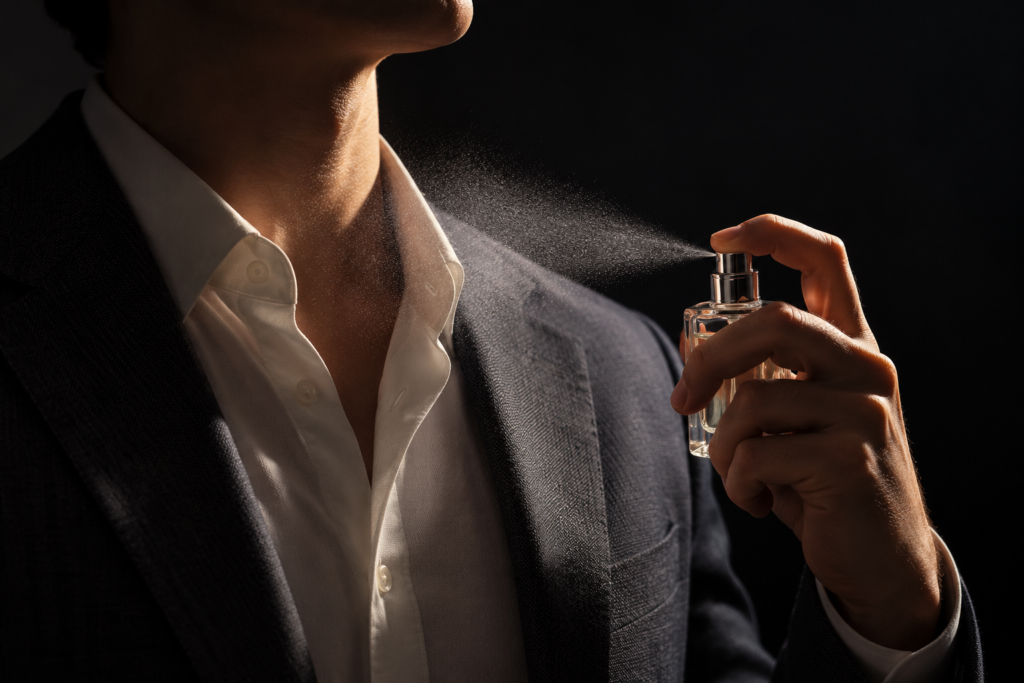
How to Test Projection, Sillage and Longevity
You do not need laboratory equipment, but a slightly more structured test produces better observations.
- Record the application. Note the number and location of sprays. Comparing tests is pointless if one involved a polite mist and the other involved attempted fumigation.
- Test on skin. A blotter is useful for studying development, but it cannot reproduce the entire wearing experience.
- Stop sniffing constantly. Check at intervals rather than pressing your nose to your wrist every few minutes (guilty!).
- Move between spaces. Leaving a room and returning can reveal whether the fragrance is still present in the air.
- Ask one trusted person. Their perception can help assess projection or sillage, especially after you have adapted to the scent.
- Note the stages. Record the opening, the period of noticeable projection, the transition to a skin scent and the point at which it becomes undetectable.
- Repeat the test. One wearing can be affected by weather, fatigue, application or simple distraction.
The goal is not to produce a verdict accurate to the minute. It is to describe the wearing experience in a way another person can actually use.
| Wanna know 10 useful tips to properly test a perfume? Check this article. |
Beast Mode, Nuclear and Other Peaceful Technical Terms
Beast mode is community slang for a fragrance with very strong performance, usually powerful projection, substantial longevity or both. Nuclear means roughly the same thing, with the added implication that nearby furniture may need to be evacuated.
These expressions are vivid and sometimes useful, but they are not technical categories. One reviewer’s beast is another reviewer’s moderately assertive house cat. If you use the label, explain the behavior behind it.
The same applies to compliment getter. Compliments measure social interaction, context and the willingness of strangers to speak, not projection in any reliable sense. A fragrance can perform beautifully while everybody around you practices the increasingly rare art of minding their own business.
Performance Describes Behavior, Not Worth
Longevity, projection and sillage matter because perfume is something we wear, not merely admire in a bottle. They affect comfort, occasion, value and personal preference. They deserve a place in fragrance criticism.
They do not deserve the entire building.
A fragrance does not become artistically superior because it lasts until the next fiscal year. A quieter composition is not automatically elegant, and a powerful one is not automatically vulgar. The useful question is whether its behavior suits the composition and your reason for wearing it.
I generally care more about longevity than enormous projection. I wear perfume primarily for myself, so I want to keep experiencing it without necessarily issuing an olfactory press release to the whole office. That is a preference, not a universal rule.
Measure what can be observed. Describe the conditions. Then return to the part that no stopwatch can answer: did you actually enjoy smelling it?
| Want the opinionated sequel? Read Why Perfume Performance Is Not a Personality Trait, where the stopwatch is allowed into the review but is firmly denied editorial control. |
Frequently Asked Questions
Is sillage the same as projection?
No. Projection is the distance a fragrance radiates from the wearer, while sillage is the scented trail it leaves in the air as the wearer moves.
Can a perfume last a long time without projecting strongly?
Yes. A fragrance may remain detectable on the skin for many hours while creating only a small scent bubble.
Does Eau de Parfum always last longer than Eau de Toilette?
No. Concentration labels can suggest a general difference, but the formula and materials determine how each version actually behaves.
Why can other people smell my perfume when I cannot?
Olfactory adaptation can make your brain pay less attention to a scent that remains constantly present. Sensitivity to individual aroma materials also varies from person to person.
[mailerlite_form form_id=1]