Francesca Bianchi: Not for Everyone
There are perfume brands built around trends, easy signatures and the reassuring idea that everybody should find something to like.
Francesca Bianchi does not seem particularly interested in any of that. Thank God!
Her current manifesto is explicit: these perfumes are not designed to chase algorithms, universal approval or the safest possible version of beauty. They are meant to generate emotion. Some people will fall for them immediately, others will need time, and some may simply never connect with them. That friction is not treated as a problem. It is part of the point.
And after spending some time with the collection myself, I am beginning to understand why.
| Disclosure: Francesca Bianchi Perfumes kindly sent me a discovery set. No payment was received and the brand had no editorial control over this article. My comments on the fragrances are based on early wears rather than full review testing unless otherwise stated. |
From Art Books to Perfume
Francesca Bianchi did not follow the traditional perfume-school route.
She studied History of Art, with a focus on twentieth-century art, and later worked in art-book publishing while living in Florence, Berlin, Luxembourg and eventually Amsterdam. Her route into perfumery began through independent study and experimentation after reading a book on natural perfumery. She launched her own line in Amsterdam in 2016.
That background matters.
Bianchi’s work often feels less concerned with illustrating a list of notes than with constructing an atmosphere. Beauty and discomfort, refinement and dirtiness, softness and something distinctly carnal are regularly allowed to occupy the same space.
There is also no ideological battle between natural and synthetic materials here. Bianchi describes them as different tools available to the perfumer, chosen according to what a composition needs to express. A wonderfully sensible position in a world that can occasionally discuss perfume ingredients with the intensity normally reserved for international diplomacy.
Her fragrances are conceived and formulated by Bianchi herself in her laboratory. Development can take anywhere from six months to several years. Once a formula is complete, the concentrate is produced in Grasse before being sent to Milan for maturation, filtration, bottling and packaging.

Perfume as Emotional Language
If there is one idea that repeatedly appears when Bianchi speaks about perfume, it is emotion.
In a 2025 conversation with Amsterdam perfume house Annindriya, she spoke about her fascination with fragrance beginning in childhood and about the connections between scent, people and memory. Asked what she would teach about perfumery, she chose its emotional impact rather than formulation technique.
That tells you quite a lot.
These perfumes are not particularly interested in being polite descriptions of flowers, woods or resins. Their notes matter, naturally, but the material is often there to construct something larger.
A mood. A tension. A memory. Occasionally something that feels slightly inappropriate.
Much better.
A Recognizable Signature Without Making the Same Perfume Twice
Spend even a relatively short amount of time around the collection and a personality starts emerging.
Iris appears frequently, as do leather, patchouli, woods, musks, balsamic textures and animalic facets. There is often richness and density, but also a fascination with contrast.
Bianchi herself has described iris butter as particularly meaningful because of its complexity, moving through powdery, earthy, green and violet-like facets. She even connected its elusive quality with the paintings of Mark Rothko.
But having a recognizable handwriting is not the same thing as repeating a formula.
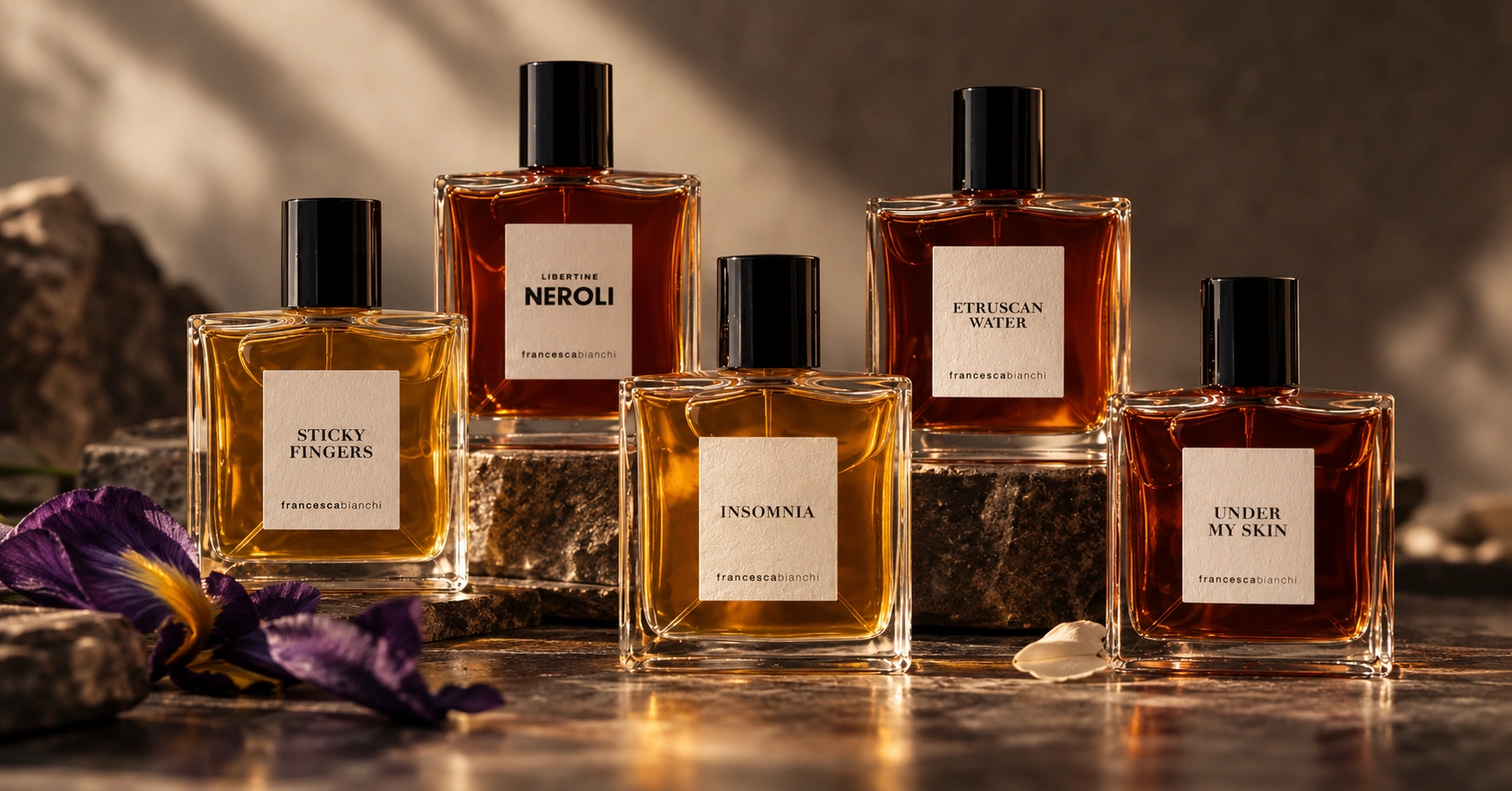
Sticky Fingers, for example, builds its rock-chic personality around patchouli, spices, tobacco, leather and iris butter. Tyger Tyger pushes narcotic flowers, honeyed fruitiness and darker woods into deliberately dramatic territory inspired by William Blake’s The Tyger. Under My Skin has been described by Bianchi herself through leathery, ambery, powdery, spicy and animalic facets, while acknowledging how differently people can perceive it.
And that seems important to understanding the brand: recognizable does not mean predictable.
The Discovery Set Problem
My own introduction to the collection came properly when Francesca Bianchi Perfumes sent me a discovery set.
Which was very generous of them.
It has also turned out to be somewhat financially irresponsible on my behalf.
I am still working through the fragrances and I am deliberately not treating first or second wears as finished reviews. A perfume can behave very differently over time, on different days and in different weather, and this site has never been particularly interested in pretending otherwise.
But some early wears have already moved alarmingly quickly from “this is interesting” to “I am going to need a bottle of this, aren’t I?”
That is all I am prepared to say for now.
Detailed reviews deserve proper wear time. My bank account, meanwhile, deserves privacy.
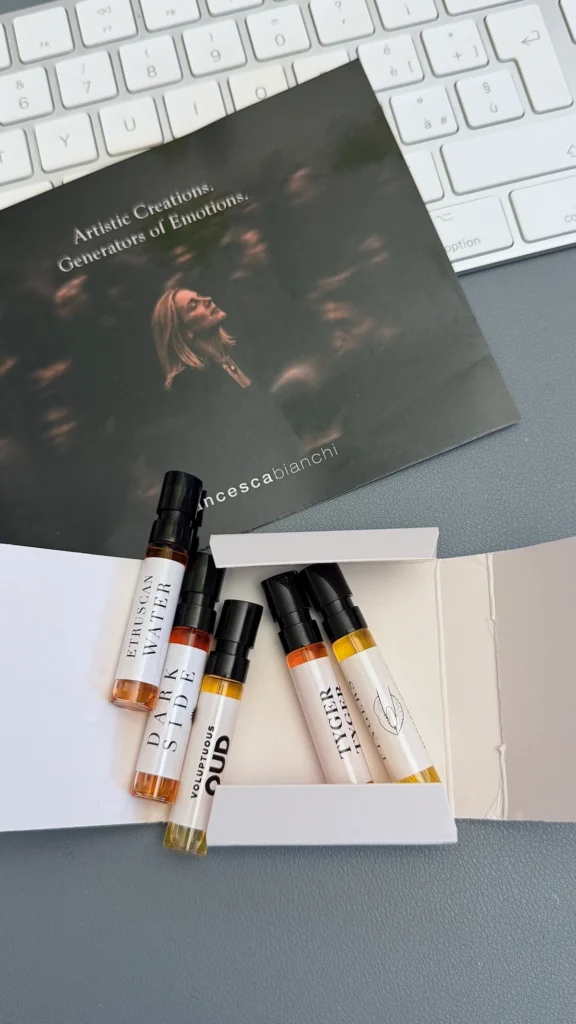
What I can already say is that this is a collection that rewards sampling rather than blind buying. In fact, the brand itself actively positions its Discovery Set as the preferred way to enter the collection: wear the perfumes on skin, live with them and see which one actually creates a reaction.
That approach makes particular sense here.
“Not for everyone” stops being a marketing slogan when a brand is perfectly comfortable with the possibility that you may smell something and decide it is absolutely not for you.
There is something rather refreshing about that.
Beauty with a Dangerous Side
The tension between attraction and discomfort is particularly easy to see in some of Bianchi’s recent work.
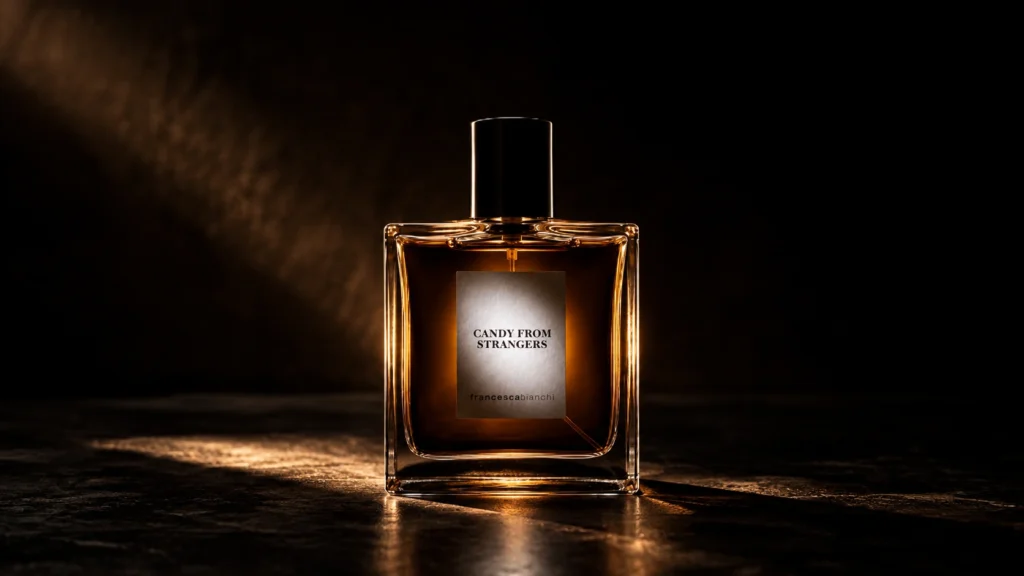
Candy from Strangers is built around citrus, iris, violet, jasmine, raspberry, leather, woods, amber and caramel. The brand describes it through the attraction of the unknown, somewhere between desire and danger. Its sweetness is deliberately presented not as comforting or innocent, but as seductive and transformative.
That idea could almost serve as a miniature description of the wider Francesca Bianchi universe.
Beauty rarely arrives completely sanitized.
There is usually texture beneath it.
Skin. Powder. Leather. Heat. Something animalic. Something slightly disordered.
Perfume behaves more like a living thing than an immaculate decorative object.
Insomnia, the Latest Chapter
And now we arrive at Insomnia.
At the time of writing, the newest Francesca Bianchi creation is in pre-order and takes the brand into nocturnal territory through a woody-floral extrait built around bergamot, black pepper and mineral notes, followed by ylang-ylang, jasmine and narcotic flowers, then sandalwood, cedarwood, patchouli, cypriol and tonka bean.
The concept is considerably more interesting than simply “a perfume for nighttime”.
For Bianchi, insomnia becomes the suspended period when the demands of daytime disappear. Deadlines, appointments and notifications temporarily lose their authority, leaving space for creativity, personal projects, conversations and the strange freedom that arrives when everyone else has gone to sleep.
That idea comes from personal experience. During the early development of her perfume work, Bianchi still had another daytime job, which meant nighttime could become the only uninterrupted space available for creation.
Anyone who has ever found themselves working on a personal project at midnight because apparently sleep is less urgent than changing one paragraph on a website may recognize the phenomenon.
Purely hypothetically.
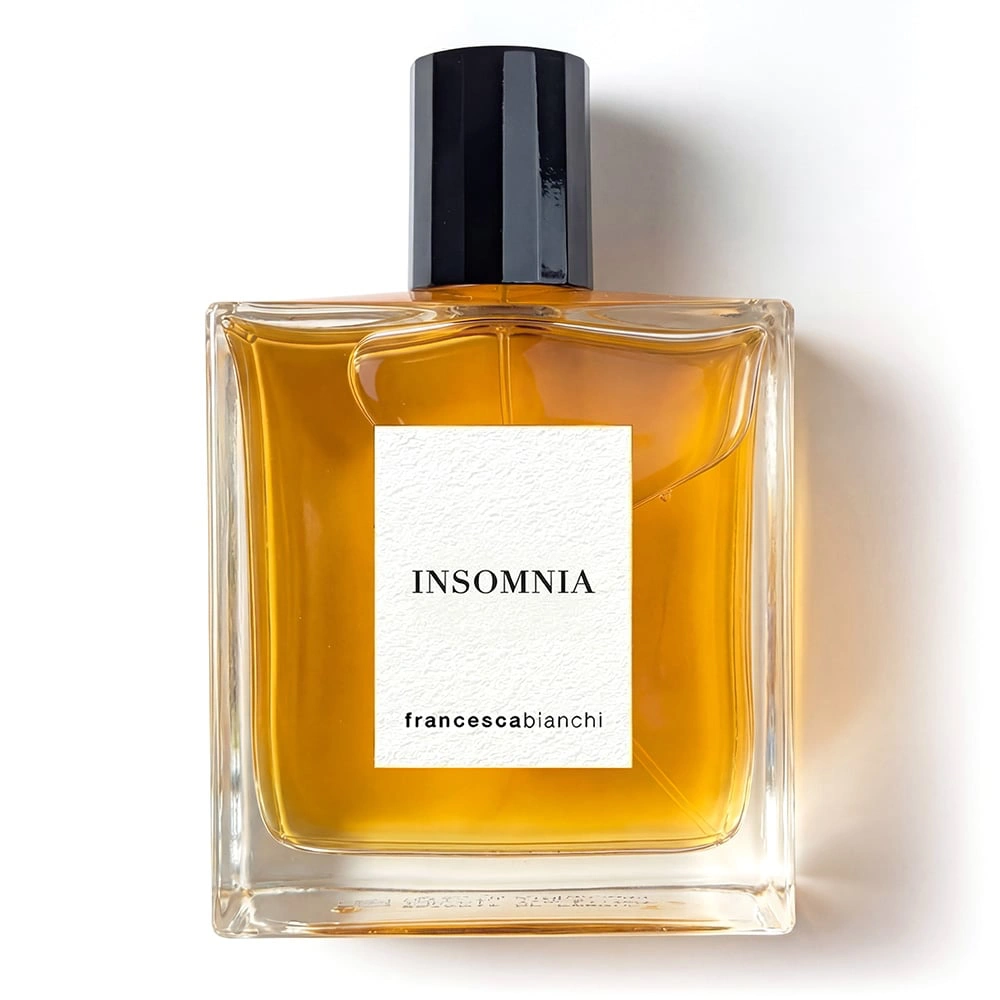
Olfactorily, the brand describes Insomnia through another of those contrasts Bianchi handles so naturally: luminous narcotic flowers against darker woods, sharpened by a mineral facet and eventually touched by indolic sensuality.
Light and shadow again.
It feels like an entirely logical new chapter.
Why Francescs Bianchi Matters
Independent perfumery does not need to be difficult simply for the pleasure of being difficult.
Nor does niche automatically mean interesting. A high price, an obscure ingredient and a solemn press release have produced plenty of forgettable perfume over the years.
What makes Francesca Bianchi compelling is something else.
There is authorship.
You can trace ideas across the collection, recognize recurring obsessions and understand that the person whose name appears on the bottle is also the person formulating what goes inside it.
There is consistency without total safety.
And there is a refreshing willingness to accept that a perfume can be beautiful while still making the wearer work a little.
I may eventually love some of these fragrances. Others may remain fascinating without ever belonging in my collection. A few, judging by these first wears, are already becoming a rather serious acquisition problem.
But indifference seems unlikely.
For a brand that proudly says it is not for everyone, that may be the best possible outcome.
| Still in the mood for independent perfume? Francesca Bianchi is certainly not the only house refusing to play it safe. Meet L’Entropiste, another brand where personality comes well before universal approval. |