You Smelled 12 Perfumes. Now What?
How to test perfume before buying it without confusing your nose
You came in to try one perfume. Twenty minutes later, you have twelve blotters, two scented wrists and a strong opinion about something you can no longer identify. One strip is magnificent. Unfortunately, nobody wrote the name on it.
This is a perfectly enjoyable way to spend an afternoon. It is a less reliable way to choose an expensive bottle.
If you want to know how to test perfume before buying it, the useful answer is fairly simple: use paper to narrow the options, wear the favorites on skin and leave enough time to discover whether you still like them. You can enjoy the perfume counter without making the purchase there and then.
Your Nose Has No Three Perfume Limit
Olfactory fatigue is real. Repeated or prolonged exposure can make an odor seem less intense. Adaptation and habituation describe related changes in the olfactory system; “my nose has given up” is the less technical version.
The biology is more complicated than receptors switching off. In a human study using repeated odor presentations, intensity ratings tended to fall for several substances, but researchers did not establish a clear corresponding decrease in the measured response at the olfactory lining.
None of this gives us a universal rule that perfume number four is impossible to assess. The studies cited here do not establish a three-perfumes-per-day limit. Keeping a small shortlist is sensible shopping advice. Three is not a biological closing time.
Notice when your comparisons stop being useful. Are you struggling to describe the differences? Returning to the same strip without learning anything? Take a break from the testers, ideally somewhere less scented. There is no need to replace one sniffing marathon with another.
Also, label the blotters. Sometimes the mystery is simply that you are holding the wrong piece of paper.
Let the Blotter Do Its Job
A blotter, or mouillette, is an excellent first filter. It lets you explore a fragrance without allocating every available centimetre of skin to a different launch.
Spray one fragrance per strip, write down its name and give the initial wet burst a moment to settle. Smell the strips separately. A fistful of overlapping blotters is an accidental fragrance collaboration nobody commissioned.
At this stage, ask a modest question: do I want to spend more time with this? You do not need a complete note breakdown. “Too sweet”, “interesting”, and “please remove this from my vicinity” are all useful findings.
Keep the promising strips and revisit them later. Paper can show development too. What it cannot tell you is whether you will enjoy wearing the fragrance through your own day.
Give the Finalists Some Skin
Once you have a shortlist, test a favorite on clean skin without another perfume already occupying the spot. If you compare two, keep them on separate areas and record which is which. For a full day of evaluation, one fragrance is easier to follow.
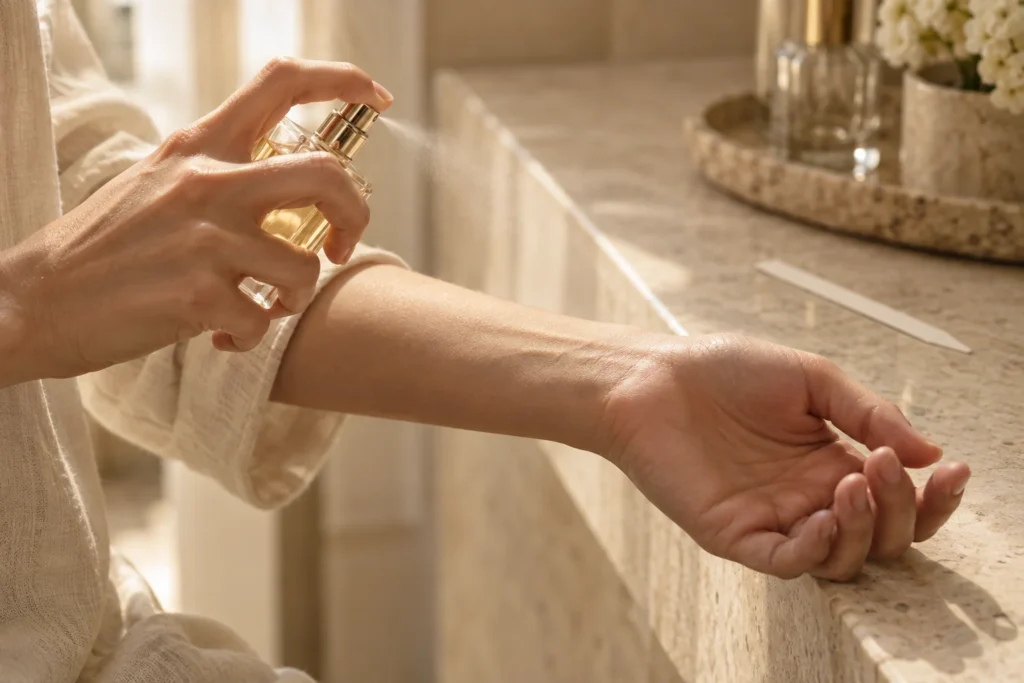
A blotter and your arm are different test surfaces. Researchers have measured fragrance release from skin and studied evaporation on both skin and test strips. That is a good reason to include a wear test, without turning “skin chemistry” into an explanation for every surprise.
Use a modest amount, note how much you applied and let it settle. Then leave the counter. You are trying to find out how the fragrance feels to wear, including how much of it you want around you.
Loving it on paper is enough to justify a sample. A bottle deserves a little more time together.
The Opening is Only the Introduction
An opening can be glorious: bright citrus, sparkling spice, an immediate sense that your life would improve with a very heavy glass bottle in it. Enjoy that moment. Just do not ask it to represent the whole fragrance.
Measurements of perfume ingredients on skin show that different components diffuse at different rates. There is no reason to treat two hours as a universal switch between the opening and the “real” perfume. Evaporation is not an event that only happens at the beginning.
The drydown is the later character you notice as the fragrance settles and wears on. Some perfumes change dramatically. Others remain recognizably themselves while becoming quieter. Neither is automatically better.
For a practical check, smell it after the first burst has settled, again later in the day and towards the end of the wear. Those are useful checkpoints, not laboratory deadlines. Pay attention to what remains: do you still like the sweetness, the texture, the balance?
You can adore the introduction and feel surprisingly indifferent about the rest. Better to discover that before checkout.
Take it Into Your Actual Life
The shop tells you whether a perfume catches your attention. An ordinary day helps you decide whether you want its company.
Wear it while doing the things you expect to do in it. If you want an everyday fragrance, try it through a working day, a walk and the journey home. If it is meant for evenings, give it an evening. Your sofa is also a legitimate destination. It just may not answer every question.
Notice whether you enjoy catching it in the air, whether it feels too present in a small room, and whether you still want to smell it several hours later. Keep the setting and application in mind when comparing different days.
Longevity matters if it matters to you, but duration alone does not make a perfume worth owning. Eight hours with something you dislike is not excellent performance. It is a scheduling problem.
Samples Buy You Time
A sample lets you test without the quiet pressure of a bottle waiting beside a card terminal. Ask whether one is available, or buy a small sample from a source you trust before committing to the full size.
Wear it on more than one occasion. Two or three full wearings can be a useful starting point, especially if the first left you undecided. Again, this is a practical suggestion, not a scientifically prescribed number of dates before commitment.
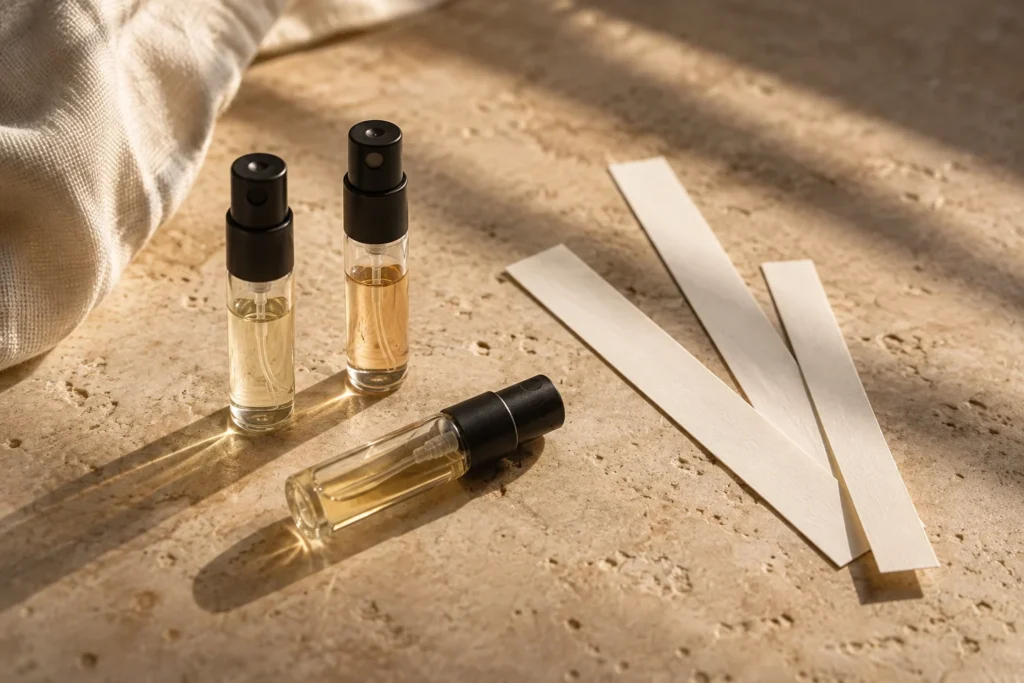
Keep the notes simple: how much you applied, what you liked at the start, what remained later and whether you wanted to wear it again. A few honest sentences are more useful than forcing yourself to detect all seventeen listed notes.
Remember that a dab from a vial and sprays from a bottle may deliver different amounts. Avoid turning one tiny application into a definitive verdict on performance.
If you keep postponing the next wearing, that is useful information too. Admiring a perfume and wanting to own it are separate pleasures.
About those Coffee Beans
The little jar beside the testers looks reassuringly official. Unfortunately, it is not a proven reset button.
In a 2011 exploratory study, participants smelled three fragrances repeatedly, then sniffed coffee beans, lemon slices or plain air. They were subsequently asked to identify a fragrance they had not smelled before. Coffee beans did not produce better performance than lemon or air in that task.
That does not prove coffee can never affect any aspect of smell. It does mean this study gives us no reason to rely on the beans as a special palate cleanser. Taking a break is a more sensible shopping habit than adding coffee and immediately resuming the sprint.
Save your enthusiasm for the espresso afterwards.
And Now Let Us Be Realistic
These are all very sensible rules. Smell fewer fragrances. Take your time. Test on skin. Wait for the drydown. Come back another day.
Excellent advice.
And then you walk into a perfume store.
There are 200 bottles in front of you, three new releases you have not smelled yet, something discontinued hiding on a bottom shelf, and a sales assistant has just said, “Have you tried this one?”
So yes, in theory, take it slow.
In practice, we all know what happens. We smell everything we possibly can.
Enjoy the exploration. Just let the bottle decision wait until you have spent a little more time with the favorite.
Consider this article good advice Linda, not a miracle.
| Still have questions, or need another excuse to smell more things? Explore our Guide section. |