D.S. & DURGA Resurrected Corpse Flower: Beautifully Macabre
Green olives, white flowers, swampy woods and a flower famous for smelling absolutely dreadful. Just another perfectly normal day in niche perfumery.
Some perfumers find inspiration in beautiful landscapes, childhood memories or romantic encounters.
David Seth Moltz went to smell a rotting flower. And apparently decided it deserved a perfume.
D.S. & DURGA Resurrected Corpse Flower is one of those creations that immediately makes you stop scrolling.
Inspired by the notoriously foul-smelling corpse flower, this Eau de Parfum explores a rather unexpected possibility: what if something genuinely unpleasant could be brought back to life as something beautiful?
With Halloween approaching, the timing feels almost suspiciously perfect.
Although, knowing D.S. & DURGA, this probably has less to do with Halloween and more to do with the brand’s wonderfully peculiar imagination.
It All Started With a Terrible Smell
In January 2025, something unusual happened at the Brooklyn Botanic Garden.
A corpse flower was blooming.
For anyone unfamiliar with this extraordinary plant, Amorphophallus titanum is famous for producing an odor reminiscent of decomposing organic matter.
Not exactly the sort of floral bouquet you’d expect to receive on Valentine’s Day.
David Seth Moltz, perfumer and cofounder of D.S. & DURGA, decided he needed to experience it firsthand.
According to his account published on the brand’s website, he visited the botanical garden during the plant’s rare flowering period.
The experience was far from pleasant.
Humid decay, rotten organic matter and strangely vegetal impressions dominated the encounter.
Among the associations he described were rubbery lily bulbs and olives.
Most people would probably have left wondering whether they needed to wash their clothes.
Moltz left with an idea.
What if all that unpleasantness could be transformed into something unexpectedly beautiful?
And so Resurrected Corpse Flower began to take shape.
From Decomposition to Resurrection
The most interesting aspect of D.S. & DURGA Resurrected Corpse Flower is that it doesn’t attempt to reproduce the original flower’s notorious smell faithfully.
Thankfully.
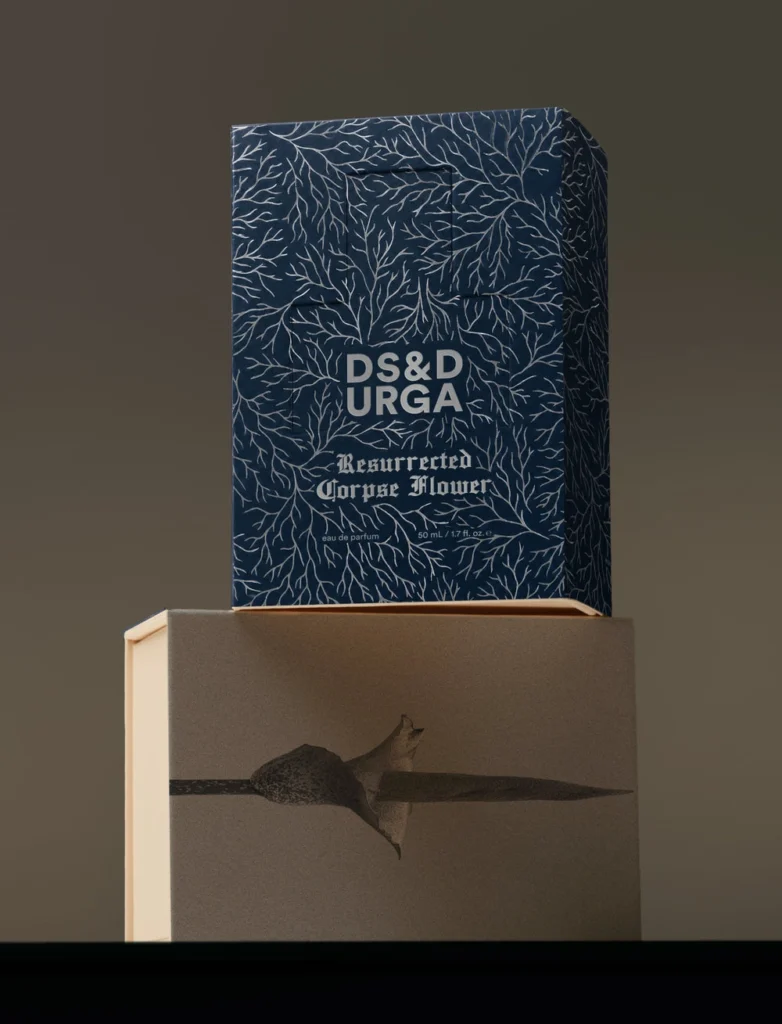
Instead, Moltz imagines what might happen if its darker, more unsettling olfactory characteristics were stripped of their unpleasantness and reconstructed.
The result is presented as a floral composition built around contrasts.
Light against darkness.
Freshness against damp earth.
Radiant white flowers against murky woods.
It’s a concept that feels particularly appropriate for D.S. & DURGA, a brand whose fragrances frequently begin with places, experiences and unconventional narratives.
Here, the inspiration is almost gothic.
A flower rises from decomposing matter, leaving behind its notorious stench while preserving something of its strange botanical identity.
Frankenstein, but make it floral.
Green Olives, White Flowers and Swampy Woods
The official note pyramid of D.S. & DURGA Resurrected Corpse Flower is wonderfully peculiar.
| Top notes | Green Olive, Balm of Gilead, Grapefruit |
| Heart notes | Freesia, Madonna Lily, Tuberose Absolute |
| Base notes | Green Banana, Bog Cedar, Papyrus |
These are the notes published by D.S. & DURGA on its official website.
And there’s certainly plenty to discuss here, Linda.
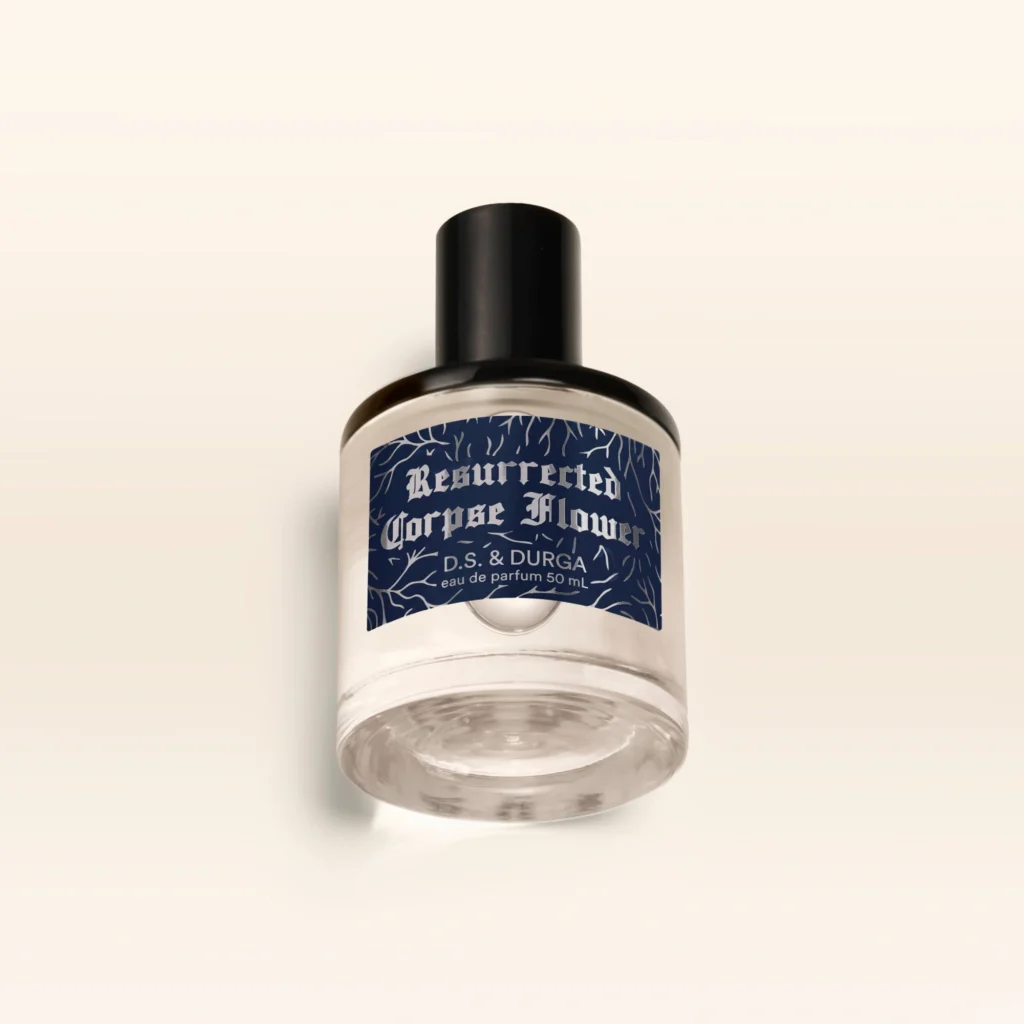
The Unexpected Green Opening
Green olive is arguably one of the most intriguing elements.
According to the brand, the olive note combines green, slightly oily and earthy characteristics.
Alongside it, grapefruit introduces a bitter citrus dimension, while balm of Gilead completes the opening accord.
On paper, this sounds considerably more interesting than another generic explosion of sparkling citrus.
There’s something deliberately strange about the idea of combining olive and grapefruit.
And I mean that as a compliment.
White Flowers With a Dark Side
The heart belongs to Madonna lily.
It’s accompanied by freesia and tuberose absolute, the latter chosen partly for its ability to connect floral beauty with more earthy, unsettling characteristics.
This is where things become particularly interesting to me.
I love white florals, especially when perfumers resist the temptation to make them excessively polished or conventionally pretty.
Tuberose can be creamy, sensual and opulent, but it can also reveal vegetal, earthy or almost disturbing facets.
In Resurrected Corpse Flower, those less obvious qualities appear central to the concept.
The lily, meanwhile, provides the composition’s principal floral identity.
D.S. & DURGA describes its lily accord as something considerably more complex than a simple sweet floral note, with spicy and animalic nuances.
An interesting reminder that flowers aren’t always as innocent as perfume advertisements would like us to believe.
The Swamp Beneath the Flowers
The base of D.S. & DURGA Resurrected Corpse Flower is equally unusual.
Green banana, bog cedar and papyrus create the fragrance’s earthy, woody foundation.
Bog cedar is particularly relevant to the original inspiration.
The brand associates it with the contrast between damp, swampy surroundings and the cleaner woody character of cedar.
Papyrus reinforces the darker atmosphere, while green banana introduces another unexpected vegetal dimension.
And no, the presence of banana doesn’t automatically mean we’re dealing with a tropical fruit cocktail.
Sometimes a banana is just a banana.
Other times, apparently, it’s part of a resurrected corpse flower.
Such is the wonderful absurdity of niche perfumery.
A Halloween Perfume Without the Usual Tricks
There’s something refreshing about D.S. & DURGA Resurrected Corpse Flower appearing during the Halloween season.
Not because it promises to smell like a haunted house.
And not because someone decided that adding a skull to a perfume bottle was sufficient to make it mysterious.
The connection is more interesting than that.
This is a fragrance about transformation.
About taking something associated with decay and imagining its rebirth.
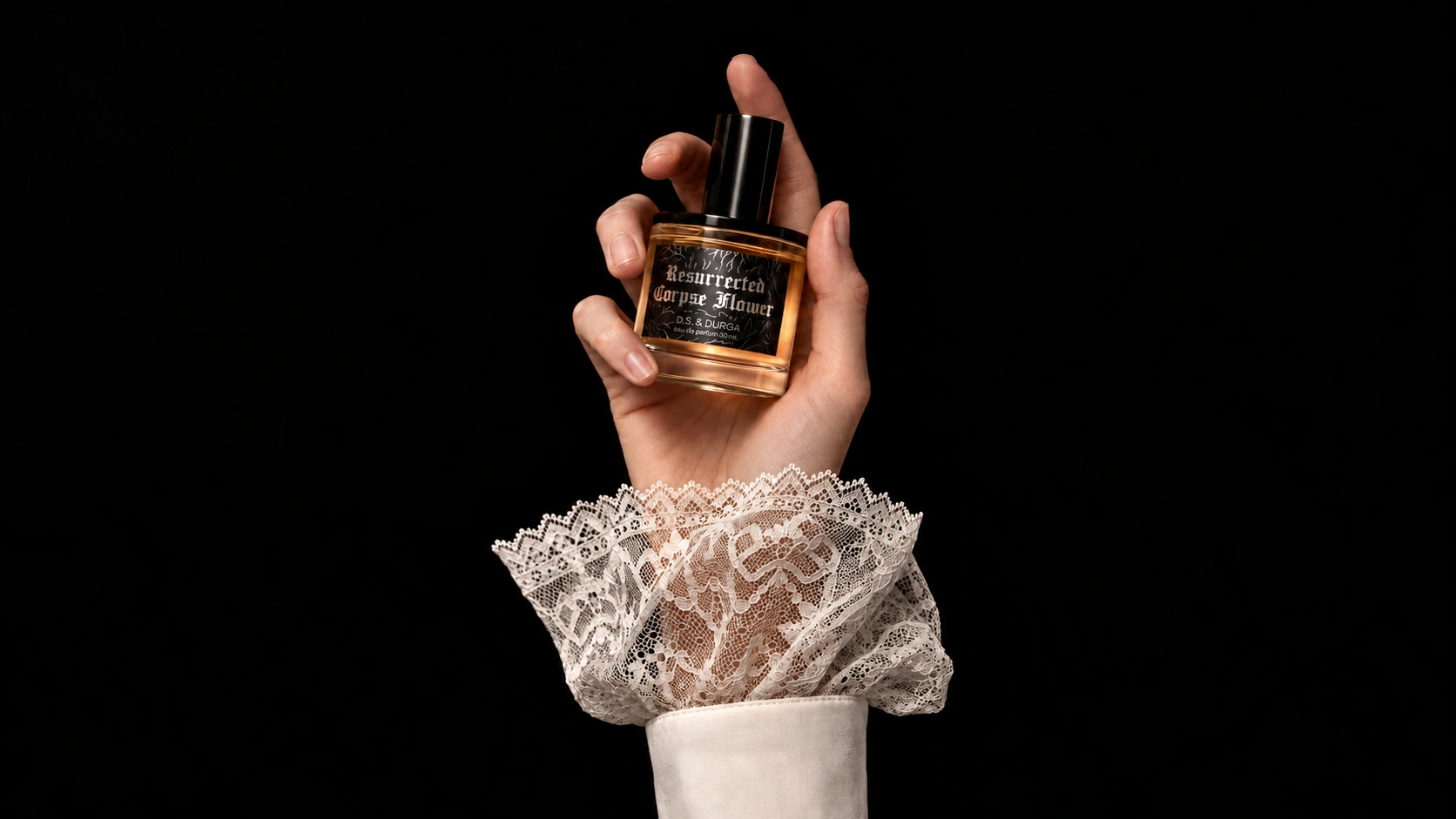
The campaign imagery reinforces that idea beautifully.
Dark backgrounds, delicate lace, botanical illustrations and a distinctly gothic atmosphere create a visual identity that feels coherent with the fragrance’s story.
It’s theatrical without abandoning the underlying concept.
And frankly, I’m delighted to see a Halloween-adjacent perfume that doesn’t rely on the usual collection of pumpkins, candy and questionable supernatural references.
Although I have absolutely nothing against a good pumpkin.
Preferably roasted.
| Fresh launches, limited editions and the occasional bottle designed purely to test our self-control. Explore the New Release section. |
Is D.S. & DURGA Resurrected Corpse Flower Worth Discovering?
On paper, absolutely.
The combination of green olive, Madonna lily, tuberose, banana and damp woods is unusual enough to deserve attention.
More importantly, there’s a genuine creative idea behind it.
This isn’t simply a fragrance with a provocative name.
It’s an attempt to reinterpret an extraordinary botanical phenomenon through perfumery.
Whether the result is beautiful, challenging, wearable or completely unexpected remains to be discovered.
And that’s precisely why testing it would be interesting.
D.S. & DURGA Resurrected Corpse Flower has not been personally tested for this article. The descriptions and notes discussed here are based on information published by D.S. & DURGA.
I wouldn’t presume to judge its longevity, projection or actual development without experiencing it firsthand.
But I will say this.
A perfume inspired by a flower that smells like decomposing matter, featuring green olives, tuberose and swampy cedar?
That’s the kind of wonderfully ridiculous idea that reminds me why I enjoy exploring perfumery in the first place.
Not every fragrance needs to smell conventionally beautiful.
Sometimes, the most fascinating creations begin somewhere considerably stranger.
Even in a botanical garden that smells like something has died.
| Editor’s Note This article is an editorial preview based on official information provided by D.S. & DURGA, including the fragrance notes and David Seth Moltz’s account of its creation. Resurrected Corpse Flower has not been personally tested. All observations about its potential olfactory character are interpretations of the published composition, not first-hand impressions. |