
Burberry Prorsum Collection: Eight Fragrances Woven Into British Heritage
Eight perfumes, 170 years of British heritage and a rather ambitious idea: translating the Burberry wardrobe into fragrance.
The Burberry Prorsum Collection explores the history of the British fashion house through eight Eau de Parfums inspired by its fabrics, landscapes, iconic garments and unmistakable identity.
From the invention of gabardine to the famous trench coat, from the English countryside to the streets of London, the collection approaches perfumery much as Burberry approaches fashion: through texture, craftsmanship and storytelling.
And, naturally, with enough references to British heritage to make you consider purchasing a trench coat before you’ve even smelled the perfumes.
But behind the beautifully presented concept lies an interesting olfactory idea.
| Editorial note: This article is based on official information published by Burberry. The fragrances have not been personally tested. Olfactory observations are interpretations of the disclosed accords, not firsthand impressions. |
The Burberry Prorsum Collection: Fragrance as Fabric
Founded by Thomas Burberry in 1856, the British house built much of its identity around functionality, protection from the elements and textile innovation.
The Prorsum Collection takes those foundations and translates them into eight distinct compositions.
Burberry describes a shared creative structure inspired by weaving. Each fragrance combines three distinctive olfactory elements with a fourth accord called the red thread.
The reference is deliberate: just as a red line runs through Burberry’s iconic House Check, a contrasting fourth element gives each perfume its own character.
It is an appealing concept because it does more than attach an attractive story to a perfume bottle. It attempts to connect fragrance construction with the brand’s actual history.
Whether the result is equally convincing on skin is another question, and one that deserves a proper smelling session.
For now, let’s explore the eight creations.
The Eight Fragrances
Garden Rain: The English Garden After the Rain
Perfumer: Caroline Sabas
Inspired by Thomas Burberry’s garden, Garden Rain captures the atmosphere of the English countryside after rainfall.

Its composition brings together spearmint extract, a violet accord and a sea-polished wood accord, with petrichor providing the distinctive red thread.
- Spearmint extract
- Violet accord
- Sea-polished wood accord
- Red thread: Petrichor accord
Petrichor is particularly interesting here. Rather than relying exclusively on familiar green and floral elements, Burberry introduces the evocative scent of the earth after rain.
On paper, Garden Rain sounds like one of the collection’s most atmospheric creations. The combination suggests freshness, greenery and a more mineral interpretation of the British garden.
It is certainly more intriguing than another perfume promising to smell like an unspecified bouquet of flowers.
Open Skies: A Breath of the British Countryside
Perfumer: Violaine Collas
Open Skies takes its inspiration from wide British landscapes, unpredictable weather and the sensation of open air.

A salty mineral accord introduces freshness, followed by an ivy accord and fir balsam absolute.
The fourth element is a vegetal accord, bringing a sharp green character to the composition.
- Salty mineral accord
- Ivy accord
- Fir balsam absolute
- Red thread: Vegetal accord
What makes this composition interesting is the tension between airy mineral notes and the deeper green character of ivy and fir balsam.
It seems designed to interpret the landscape rather than simply reproduce the smell of a forest.
For lovers of green fragrances, this could be one of the most compelling compositions in the collection.
British weather may be unpredictable, but at least this time someone has attempted to turn it into something desirable.
Gabardine: The Fabric That Started It All
Perfumers: Nisrine Grillié and Yann Vasnier
Few materials are as closely associated with Burberry as gabardine.
Invented by Thomas Burberry in 1879, the breathable, weather-resistant fabric became one of the foundations of the house’s identity.

Gabardine Eau de Parfum translates that textile heritage into a composition built around a gabardine-inspired accord, jasmine sambac absolute and powdery musks.
White cedarwood provides the red thread.
- Gabardine-inspired accord
- Jasmine sambac absolute
- Powdery musk accord
- Red thread: White cedarwood
This is one of the fragrances I find particularly interesting from a conceptual perspective.
The combination of jasmine, powdery musks and cedarwood suggests a balance between floral luminosity, softness and structure. The presence of jasmine sambac is particularly interesting here. For a closer look at the flower’s many personalities, explore my guide to jasmine in perfumery.
There is something appealing about the idea of a perfume inspired by fabric without simply promising to smell like freshly washed laundry.
Whether it evokes the sensation of wearing a beautifully tailored garment remains to be discovered.
Est. 1856: Where the Burberry Story Begins
Perfumer: Florian Gallo
Named after the year Burberry was founded, Est. 1856 looks back to the house’s beginnings in Basingstoke, Hampshire.

Its inspiration is the atmosphere of the early Burberry shop, with references to craftsmanship, traditional textile production and leatherwork.
Frankincense oil, cedarwood oil and a leather accord form the central composition.
A Longjing tea accord provides the red thread.
- Frankincense oil
- Cedarwood oil
- Leather accord
- Red thread: Longjing tea accord
The contrast between incense, leather and tea is what makes this fragrance particularly intriguing on paper. Leather is also one of perfumery’s most versatile accords, moving between polished elegance and darker, more textured interpretations. My Ombré Leather guide explores just how different those interpretations can be.
There is an interesting dialogue between traditional materials and the aromatic freshness associated with green tea.
Rather than presenting heritage as something dusty and untouchable, this composition appears to explore its more contemporary possibilities.
And frankly, incense, leather and tea sound like a considerably more interesting way of celebrating a company’s founding date than another commemorative logo.
Knight: The Equestrian Emblem in Fragrance
Perfumer: Tanguy Guesnet
Knight takes inspiration from Burberry’s famous Equestrian Knight emblem, introduced in 1901.

The fragrance combines an English berry accord, rose extract and a white oud wood accord.
Saffron is the red thread, adding a metallic nuance intended to recall the knight’s silver armor.
- English berry accord
- Rose extract
- White oud wood accord
- Red thread: Saffron accord
The composition suggests a contrast between fruity freshness, floral richness and a deeper woody character.
Saffron brings an additional dimension, particularly through the metallic effect described by the brand.
Knight is perhaps one of the collection’s most theatrical concepts, although turning a medieval-looking emblem into fragrance is certainly an ambitious exercise.
The combination of rose, oud and saffron is familiar territory in contemporary perfumery, so the real question will be how Burberry distinguishes this interpretation.
Kensington Trench: The Iconic Coat, Reimagined
Perfumer: Meabh McCurtin
If there is one garment that defines Burberry, it is the trench coat.
Kensington Trench draws inspiration from that enduring symbol of protection, practicality and British elegance.
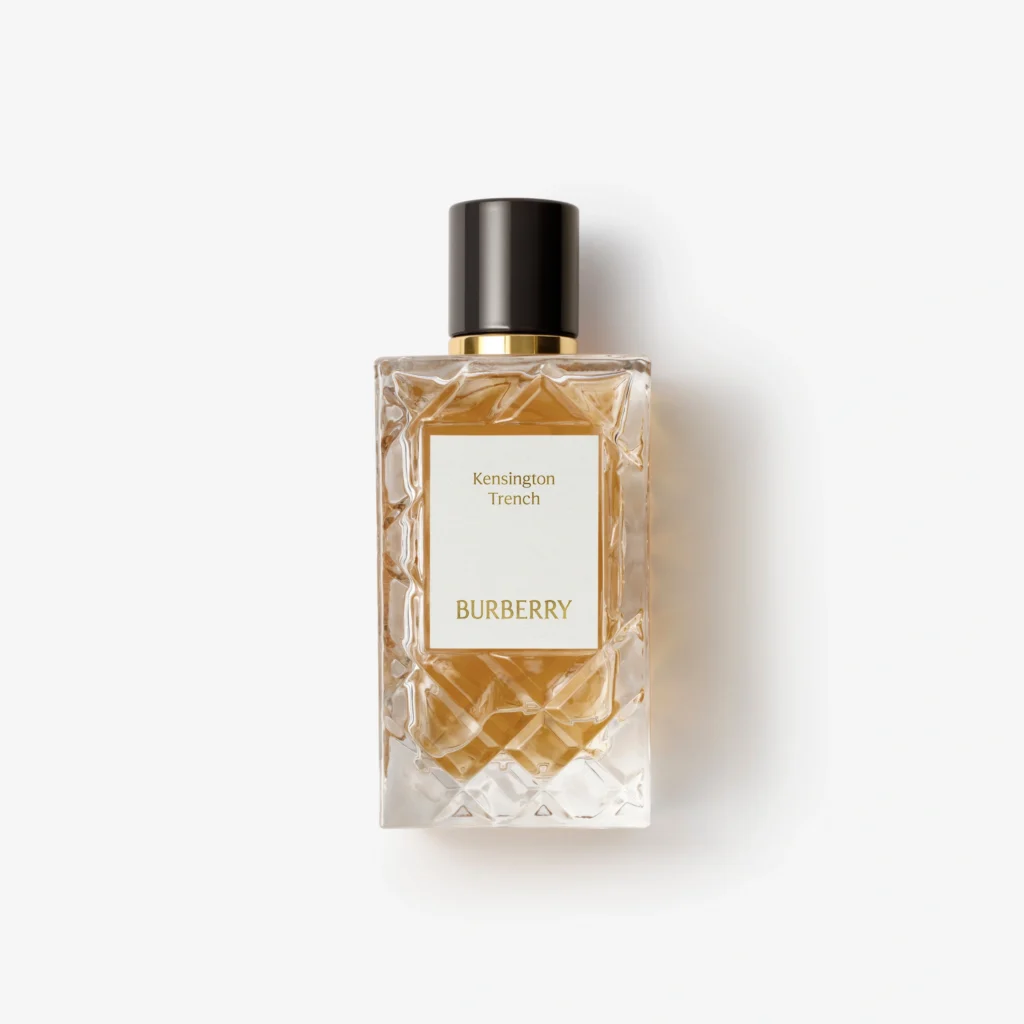
The composition combines a clean cotton accord, cashmere wood accord and vanilla absolute.
A morning rain accord completes the structure.
- Clean cotton accord
- Cashmere wood accord
- Vanilla absolute
- Red thread: Morning rain accord
This is another particularly interesting interpretation of texture.
Cotton and cashmere wood suggest softness, while vanilla adds warmth. The rain accord introduces a contrasting element that connects the fragrance to Burberry’s longstanding relationship with the British weather.
On paper, Kensington Trench seems to explore the comforting side of the collection.
The perfume equivalent of wrapping yourself in a beautiful coat on a cold morning, perhaps.
Although the coat is unlikely to cost less than the fragrance.
London: The City in All Its Contradictions
Perfumer: Mathieu Nardin
London is inspired by the energy and eclectic character of the British capital.
Rather than relying on an obvious interpretation of urban freshness, Burberry has chosen an unusual combination.

Licorice root absolute, patchouli extract and a light woods accord provide the structure, while orange marmalade adds the red thread.
- Licorice root absolute
- Patchouli extract
- Light woods accord
- Red thread: Orange marmalade accord
Yes, orange marmalade.
It is an unmistakably British reference, bringing breakfast into an olfactory composition inspired by one of the world’s busiest cities.
Yet the combination is intriguing.
Licorice and patchouli suggest depth and character, while the orange marmalade accord introduces a potentially playful contrast.
Among the eight fragrances, London is certainly one of the compositions that raises the most questions.
And that is usually a good reason to want to smell something.
Cashmere Embrace: A Softer Interpretation of Luxury
Perfumers: Nisrine Grillié and Yann Vasnier
Cashmere Embrace explores the warmth and softness of one of Burberry’s most recognizable materials.

Inspired by the sensation of wearing a cashmere scarf on a cold day, the fragrance combines a cashmere accord, ginger oil and sandalwood oil.
A sandy vetiver accord provides the fourth element.
- Cashmere accord
- Ginger oil
- Sandalwood oil
- Red thread: Sandy vetiver accord
The concept is built around warmth and texture, but the ginger and vetiver introduce interesting contrasts.
Ginger may bring a brighter dimension, while vetiver adds an earthy quality to the composition.
Rather than relying entirely on creamy and comforting notes, Cashmere Embrace appears to introduce a more structured interpretation of softness.
An appealing idea, particularly for those who enjoy woody fragrances with a refined, enveloping character.
Eight Perfumes, One Visual Identity
The bottles deserve their own moment.
Each 100 ml Eau de Parfum comes in a glass flacon featuring a sculptural interpretation of the Burberry House Check, with a colored cap associated with its fragrance.
The Equestrian Knight emblem completes the presentation.
The design manages to be decorative without losing the recognizable identity of the house.
And while the collection draws heavily on heritage, the bottles feel contemporary rather than nostalgic.
This is particularly important when a fashion house moves into a more exclusive fragrance territory: the packaging needs to communicate an identity of its own.
Burberry has certainly paid attention to that part of the equation.
Which Burberry Prorsum Fragrances Look Most Interesting?
Based exclusively on the officially disclosed compositions, several fragrances stand out to me.
Gabardine immediately catches my attention because of its combination of jasmine sambac, powdery musks and white cedarwood. The textile inspiration is also particularly convincing within the Burberry universe.
London is perhaps the most unexpected on paper. Licorice, patchouli, pale woods and orange marmalade are not a combination I encounter every day.
Garden Rain offers another intriguing concept, especially through its petrichor accord.
And Est. 1856, with incense, leather, cedarwood and Longjing tea, deserves serious consideration.
These are not fragrance reviews or predictions of how the perfumes will perform. They are simply the compositions I would be most curious to explore.
Because a beautifully written description is one thing. What happens when the fragrance reaches the skin is quite another.
A New Chapter for Burberry Perfumery?
The Burberry Prorsum Collection is interesting because it appears to approach fragrance as an extension of the house’s creative identity rather than simply another seasonal launch.
Its strongest idea is the relationship between textiles and perfumery: materials, textures and accords woven together to create a particular olfactory character.
It also raises a familiar question about luxury fashion houses entering more exclusive fragrance territory.
Can heritage, beautiful packaging and carefully constructed storytelling justify the move into a more elevated segment of perfumery?
Possibly. But ultimately, the answer has to come from the fragrances themselves.
For now, Burberry has presented eight distinct interpretations of its British identity, and several of them sound genuinely interesting.
I would particularly like to discover whether Gabardine translates the sensation of fabric into something recognizable, whether Garden Rain delivers a convincing petrichor effect and just how much orange marmalade London dares to introduce.
Because if Burberry can make British rain, gabardine and breakfast preserves smell luxurious, I would call that a rather impressive achievement.
| Eight fragrances, 170 years of British heritage, and plenty more to discover. Explore the latest launches in the New Releases section. |